
For many authors, the only real way to get our books out is by attending events. Events look different for writers of every genre. In this blog, I’ll go over a few different types of events and what to expect from them, tools for smooth events, some no-nos of events, and some tips for getting into events and prepping for them.
Types of Events
Author Fairs/Book Fairs (Multiple Authors, Same or Multiple Genres)
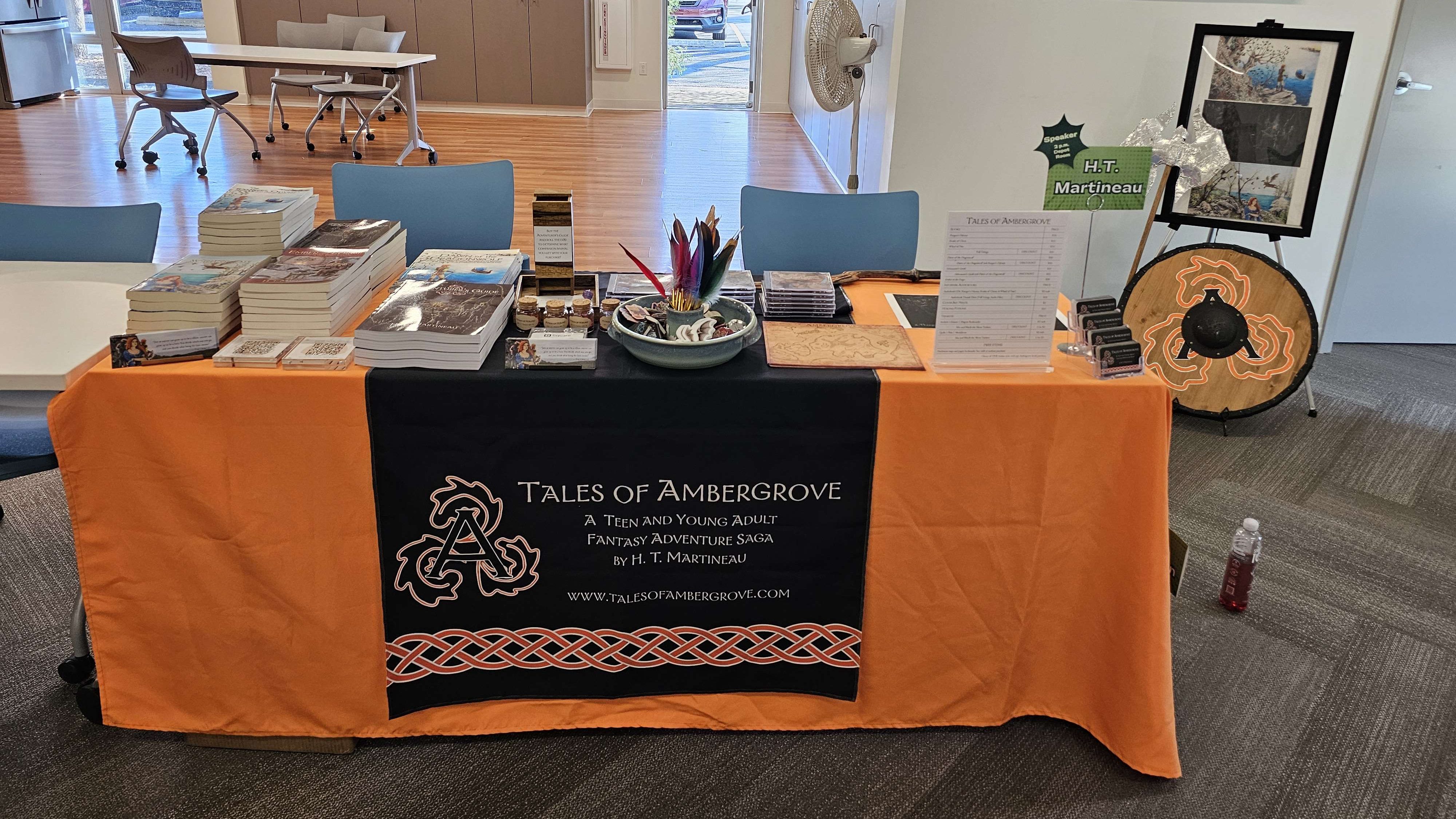
These events are typically free to attend or are very affordably priced (usually no more than $25). Reach out to your local libraries and independent bookstores for their particular application processes. An event like this will likely have 10-30 other authors all set up at tables around the building. You have your own space and are usually provided a table and one or two chairs. You’ll arrive about an hour before the event starts, setup your table, and have the chance to talk with other authors around you. Take that opportunity. Talking with other authors is a great way to learn more about other writing and publishing methods, event practices, other events, and cool books you may not otherwise have heard about. A lot of these events also include panels or individual talks. The author is expected to handle all sales at the table.
I also do “tradesies” at most of these sorts of events. If I am interested in another author’s book(s) and they are interested in mine, we will trade book for book or series for series.
At the end of the event, you can typically choose to leave copies of your books for the shelves—either a copy for library circulation or a few copies for store availability. Most bookstores will carry on consignment: you give them the books and they sell them for you, keeping a cut. This is the lowest risk for stores. Some will do wholesale, wherein they will buy the books from you at an agreed-upon price, and then they retain all profit from the sale. ALWAYS go for library availability. Libraries are not your enemy; what you lose in sales will be minimal compared to the goodwill and the readership you will gain.
Some I have attended:
- Enchanted Novelties (Harrison, Ohio, bookstore): Childrens and YA Book Fair
- Lawrenceburg Public Library District (Lawrenceburg, Indiana): Author Fair
- Monrovia Public Library (Monrovia or Martinsville, Indiana): Author Fair
Bookstore/Library Readings, Workshops, Releases (Individual)
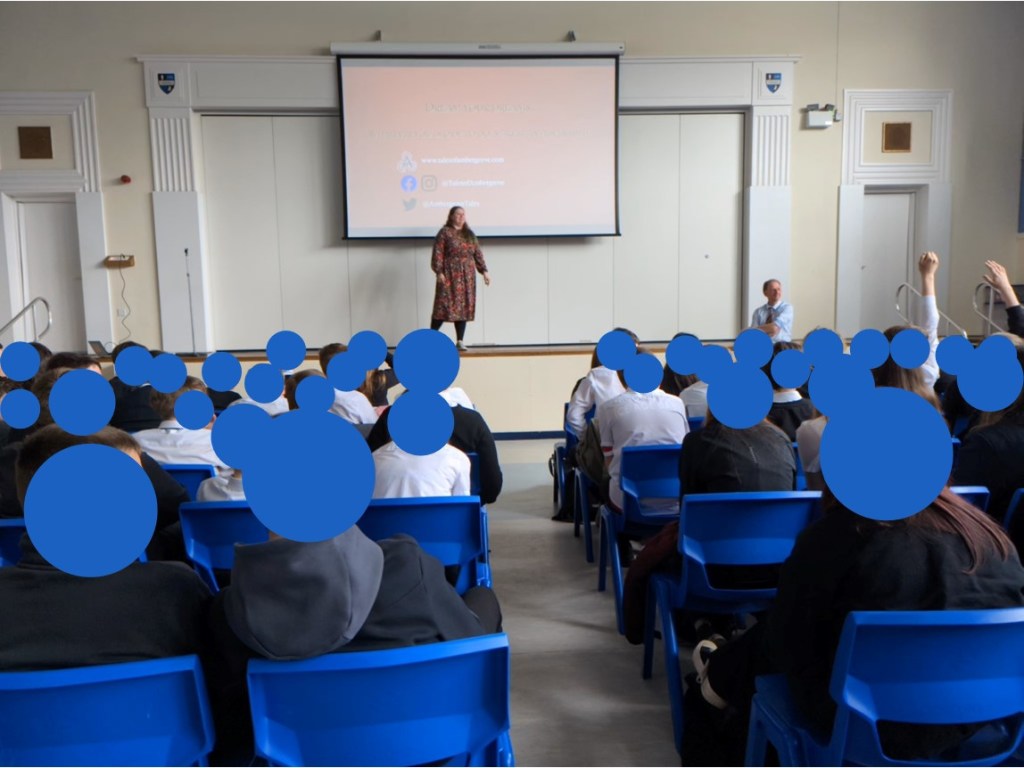
These are typically solicited events. They require authors or agents to reach out to see if the location is interested in doing an event. In some cases, prior events can lead to individual events (attending the author fair at Monrovia’s library prompted the organizer to reach out about workshops and the summer reading program two years in a row). Either way, these events are set up on a case-by-case basis. I just had the new book for the book release, and the bookstore advertised. I just made a PowerPoint for the school presentation, and the teachers and school librarian organized everything; I didn’t bring any books except a couple copies to show the students during the presentation. Monrovia’s librarian had the idea that I do some workshops, and after we’d decided on subject matter together, I created the whole workshop. In any case, an individual event requires more attention, dedication, and involvement in creation, preparation, and execution.
Build solid relationships in the group events you attend. Besides being professional and recommended simply for goodness’ sake, those relationships open doors for individual events. Returning somewhere for an individual event draws in return readers.
Develop a professional pitch for bookstores, libraries, and schools (if applicable) to see if they are interested in hosting an individual event. Tell them what books you have, what experience you have with events, how successful your books are (however you measure that success), and what you could provide for an individual event. Be prepared to put some money into preparing materials or purchasing stock—whatever the organizer asks that you are willing to provide. Otherwise, there shouldn’t be any upfront costs or registration fees of any kind.
Some I have attended:
- Morgenstern’s Bookstore (Bloomington, Indiana): Book Release (Wheel of Fate)
- Orb’s Bookshop (Huntly, Aberdeenshire, Scotland): Reading, Q&A
- Webster’s High School (Kirriemuir, Angus, Scotland): Presentation, Q&A
- Monrovia Public Library (Monrovia, Indiana): Workshops, Summer Reading Events
Genre-based Events, Community Events (Renaissance Faires, Conventions, Fall Festivals, County Fairs)
The heavy-hitter events are going to be your fairs and conventions. While these come with a lot of reach in readership and often a lot of profit, there’s also a lot of upfront costs. Libraries, schools, and bookstores often provide most of what you need and don’t charge for it. Conventions and fairs require authors to register as vendors and pay a booth fee, and fairs often require their vendors to provide tables, chairs, and a tent in addition to their other materials. Depending on the size and popularity of the event, registration can be anywhere from $75 to $300, $1000, and up for a single weekend or a full run (4-8 weekends).
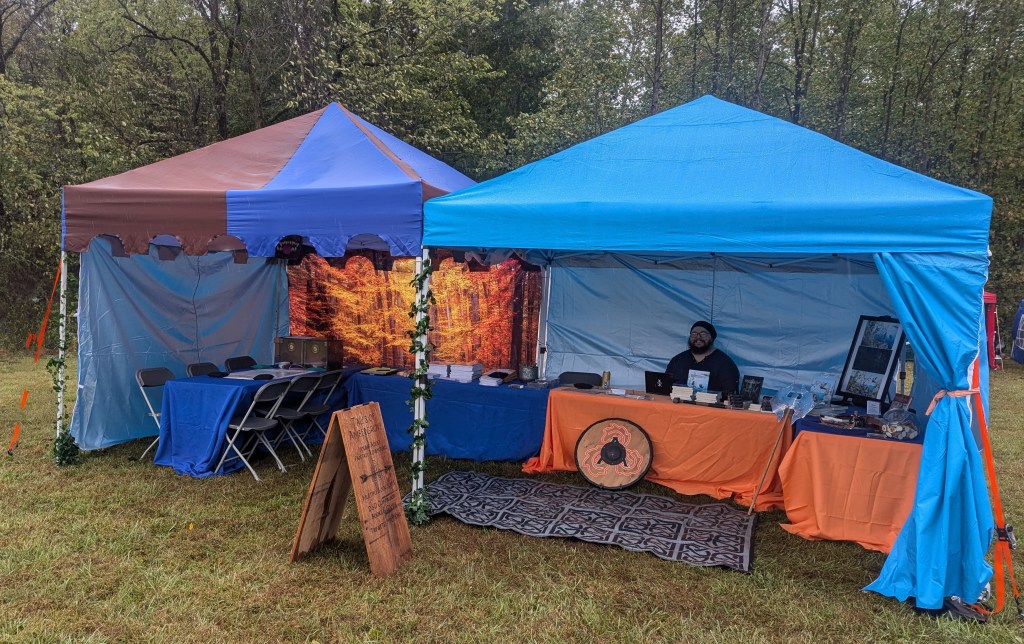
It’s important to plan many months ahead for these types of events, sometimes even over a year. GenCon registration is 13 months before the event. Many fall events have registration ending in January. Competition for these events is fierce, so when preparing to apply, you’ll need to have as many materials for your booth as possible—multiple books, maybe pins or stickers, related items (healing potions for me). If you can offer something else, include that. I run a D&D one shot at my booth. Getting accepted to an event like this is the first hurdle. The second hurdle is paying for the event. I typically make back over double what I spent for the events when I do these types of fairs, but I have to be sure to have the money to purchase bulk book stock (usually at least 50 copies of each book) as well as money for the registration fees and any other supplies—tables, chairs, pop-up tents, the canopy covers (left tent in the image below).
While simply looking into events you already know of and are interested in ensures that you can apply for at least a few events, not all are widely listed. Conventions may have their own database, but there’s at least one convention in every state. Often, there are multiples. Fairs and festivals are almost all catalogued here, in a database that lists each chronologically by state. I’ve discovered dozens of events by looking through and recording the ones I wanted to apply to in the future. Look through the listings for each state you’re willing to travel to, and then look up each event that piques your interest. Most specify who to contact for application/registration, when the window opens, and what the booth fees are. Many of these can be consistent readership builders, as once you’re in for the first year it’s easier to get back in for future years.
Some I have attended:
- Clayshire Castle Medieval Faire (Bowling Green, Indiana): regular beginning in 2024
- Indiana Enchanted Fairy Festival (Bowling Green, Indiana): coming 2025
- Ohio Renaissance Festival (Harveysburg, Ohio): Fantasy Weekend, Viking Weekend, Tricks and Treats Weekend; 2021-2023.
- Southern Indiana Renaissance Faire (Seymour, Indiana): Celtic Weekend, Fantasy Weekend 2025 (coming soon)
Taboos
Authors can be desperate to make sales at events—to cover costs, break even, or ensure profit goals. This can sometimes result in taboo behavior. The first thing to remember at an author fair or book fair is that all the other authors have similar goals and challenges to yours. These events are not meant to be cutthroat me-before-you events. If someone is talking to readers at their table, even if your books are similar and you see an “in” immediately, don’t insert yourself when another author is talking to potential readers. At an event this year, I saw another author grab business cards and interrupt reader conversations with other authors to give out business cards and draw people over to their table. That author sold the least amount of books of the handful in the same room and many of the author’s business cards were in the trash when we were leaving. Because that kind of pushiness is a no-no. Yes, we want our information in readers’ hands, but if you make someone feel obligated to take your information, on the spot, they’re not likely to want anything to do with it. If you interrupt other authors and take time with readers from them, you are souring yourself toward others in the industry who may have otherwise wanted to help you. I sat next to an author at my last event who was kind to me and remembered me from the previous year. Her books are fantastic, and I ushered people to her. She ushered people to me. We talked shop. Events are fantastic for forming bonds with other authors if you conduct yourself respectfully.
Don’t bad-mouth other authors or the event while you’re at the event. Talking disparagingly about someone who was late or whose booth isn’t what you expected, complaining about table size or location, or openly talking about whether you made enough money at the event is poor form. Attendees notice those things. Organizers notice those things. Having a poor attitude may get you booted from the event next time or sour you to other authors or vendors who may otherwise want to help you.
Show attendees that you want to be there—and be professional. Lounging back in a chair and messing around on your phone shows that you aren’t interested in communicating with attendees. They’re less likely to come to your booth and ask you questions if they feel like they are bothering you by doing so. At my last event, we were given lunch, and the authors at many tables were openly eating. I had my food on the box behind my table and was taking single bites and remaining outwardly attentive. Two attendees skipped other tables and came to mine, telling me verbatim, “Everyone else seems to be having lunch, so I didn’t want to bother them.” Those attendees didn’t come back around to check out the tables they missed, but they did get information from me. One bought a book. Strive to be friendly and approachable. You can update your author socials at the start of the event, but otherwise, stay off your phone and appear attentive from start to finish.
Overall, just be kind, be present, and be professional from the moment you arrive to the moment you leave.
Tools and Tips
Make sure you have a reliable card-taking method. Sometimes people bring cash to events, but not always. We’re in an age when card is king. Square is free. So is PayPal. Give readers a few options and make sure you understand the system you’re using. I use Square and have it on my iPad with data—so it isn’t reliant on WiFi at the event being available. I purchased the chip reader for Square for ease of transactions. Some authors choose to have everything listed online and provide scannable QR codes for online purchases. Be sure to also have a way to take cash. Older readers may not want to/be able to scan a code and do it all on their phone. Your cashbox should have $50-$100 of smaller bills in it at the start of the event. I typically take out $100 ($20 in 1s, $40 in 5s, $40 in 10s). That has historically been enough to ensure there’s change when readers pay with twenties. I don’t take larger bills.
Table Staples:
- A colorful tablecloth: pick a color that goes with your books, either that fits the theme somehow or matches the covers. I chose orange for mine because the series logo is orange.
- Printed price signage: print off prices and any discounts you run and display those in picture frames, 8×10 standees, or blocks to keep the paper professional and ensure prices are displayed and legible.
- Always have something free: I have parchment maps and bookmarks free without purchase. The bookmarks look nice and include all my info. The maps are interesting and may garner further interest in the world. If you provide free options, readers are more likely to take your information and purchase later (or read from the library).
- Invest in a table runner or other professional signage for your table.
- Bags: get paper bags or plastic bags for your books and give readers the option. I have larger plastic bags for most events and paper bags for specific other events. I’ve printed labels with my information and put them on the paper bags.
- A collapsible cart: I got a folding wagon a couple years ago, and that thing is my best friend. I can park far out, load everything into the wagon, and easily walk wherever. Once I’m set up, I can break down the wagon and slide it under a table until I need to load it back up.
- Plastic tubs: I have collapsible plastic tubs, though they’ve never been collapsed. Measure your books to ensure you can fit at least two wide in the tub and stack your other materials in there with the books. If you’re publishing Amazon Direct, don’t have a visible Amazon box. Use an unmarked cardboard box or a plastic tub.
For Outside Events:
- Put some thought into your canopy tent. Setting up a canopy can be the most frustrating part of this process. I’ve been using pop-ups for years, and my favorites are Crown Royals with sidewalls. They’re sturdy and easy to set up. The ones I have now are extremely user-friendly models, and we can have the tents up or down in under 10 minutes.
- Have a plan for setup and teardown that works in the rain as well as the sun. Most places require vendors to wait until the moment the event closes or until after the last patron leaves to start packing the booth. If you make sure you have an efficient plan, you can be packed and ready to go quickly (and without standing in the rain or in the dark as much.
- Always have: a flashlight (a real one, not a phone light), scissors, tape, bungee cords, binder clips/safety pins, bags for trash, paper towels, small snacks like granola bars (even if you plan to go get food at a booth), water or Gatorade, ratchet straps (for better securing the canopy if wind is expected), twine or other string (you’d be surprised what may be solved with some string), a notepad, permanent markers, and something else to take notes with.
General:
- Pack your boxes in reverse order. Your tablecloth and runner should be at the top of one of your boxes, so you can take them out first and pile other things on top. Next down should be any receptacles, like book stands or card holders. When you repack, you’ll also do books and items, receptacles, tablecloth, so when you are ready to set up the next time, you can start with the tablecloth again.
- Have any card reader and device out separate to be charged the night before. In case of battery issues, also have a charged powerbank of some kind to use if needed.
- Print any directions from the event coordinator to ensure you have a physical copy if you don’t have cell service or have any other issues when you arrive.
I’m certain there’s things I’m forgetting and things I’ll learn in future events. Always be willing to share what you learn. There’s no reason to gatekeep here. Best of luck at your coming events!
 Tales of Ambergrove
Such a useful post! Been thinking about doing events for a while and have had no idea where to start.
LikeLiked by 1 person
Happy to help! Feel free to reach out if you have questions! I’ve been doing events for five years, so if I don’t have an answer, I should at least know where to send you!
LikeLike