Authorly Advice 8: Handling the Possibility of an Incomplete Series—Just in Case

It has been a couple months since the last Authorly Advice blog, and that is due in part to this month’s topic: preparing series or worlds in the event that you may not be able to complete them in a timely manner (or ever).

I should preface this by saying that this year began with my getting a traumatic brain injury. Still now, nine months later, I am having major issues with life tasks and writerly tasks that used to come naturally to me. If I actively try to think about something—anything—my brain just fizzles into blank static. This happens when I try to remember something someone said to me, when I try to come up with story details, or when anyone asks me a question of any kind.

I’ll say something, and then two seconds later, my husband will ask, “What did you just say?”
*static*

I’ve been working this entire year on memory care and other brain therapy to restore my previous function, but the neurologist told me flat-out that I may never regain my previous function—and if I do, it may not be for a year or more. I’ve now firmly slid into the longest period between novels since I published my first novel in October 2020. Yes, there have been four novels and two companion books in the past five years, but Ember in the Forge was published two years ago. It has been two years between novels. Part of that was due to my work on the D&D core book and part to some personal matters that took precedence, but there was six months between the first book and the second book. I know the story, but when I sit down and try to write, my brain fizzles into static after less than an hour. Every time. So I’ve started to make preparations just in case I lose my ability to continue to write my novels. I’m not there yet, but I want to make sure I’m prepared in case I do get there.

Readers and Incomplete Series

“Cliffhanger” from Between the Lions

Many readers will see the first book in a series—or any incomplete series—and choose not to start the series until it’s finished just in case it’s never finished. Most series that are started are finished, but sometimes an author will pass away in the middle, will have some sort of incapacitating accident, will no longer be able to secure publishing, or will just decide to give up on the story.

Perhaps one of the most known modern incomplete series is Game of Thrones. I believe we may be nearing a decade or more since the last possible update on Winds of Winter (the next book in Martin’s planned series), and it has become a running joke that the story will never be finished. When the TV show passed the completed timeline, the showrunners were given more creative freedom with the later episodes. It is often argued that the reason the final season was so widely disliked was because the showrunners ran out of source material. A show that was beloved was then ended in a way that left many fans feeling like their time had been wasted.

Many readers—understandably—do not want to take the chance that a story will remain unfinished or will be picked up by someone who will canonize a story that may go against what was estabilshed. If a story remains incomplete, the cliffhangers left like that poor guy in Between the Lions in perpetuity, readers will be left unfulfilled as well. While those who really know us will (or should) care about the “why” behind an incomplete series, readers will be more disappointed in the story left without an ending. Some readers may never experience your world at all because they know that it is incomplete and will remain so. Some will try to fill the gaps on their own. While fanfiction should be encouraged, a story left incomplete opens the door to conflicting stories, arguments, and perhaps a fan theory becoming canonical simply because the author never finished and someone had to.

Preparing for the “Just in Case”

If you care about your world and the stories you have created for it, and you have series planned but not written, prepare for the “just in case” so that you have something together if the writing stops.

Whether you’re a planner, a pantser, or a plantser, there is some element of the series you can create a notes file for. In a series, even pantsers have to do a certain amount of planning to ensure there are no continuity errors between novels. That is where to start.

The amount of series trajectory notes you have depends on how many series you have planned. Let’s start with one series.

Preparing a Single Series

Actually preparing a single series can be difficult, especially for pantsers, but the idea is to write down anything that is important about the story just so it’s written somewhere. Even the pantsiest pantsers know how they want the story to end. Even if they allow the story to take them on a journey, and the meat of it changes based on how the characters transform in the writing, they know where they had intended it to go.

Completing notes for a series can be as simple as saying:

  • “In this romance duology, the main character will fight with the love interest about something that seems to be relationship-ending, there will be some secondary love interest that comes in, but the MC will eventually end up happy with the book 1 love interest at the end.”
  • “In this crime trilogy, the detective will have a setback related to a personal issue with the second victim. The murderer will be seemingly revealed at the end of the second book, but that’s actually a frame job. The third book will reveal that the murderer is actually the CSI who has seemed a little too helpful the whole time.”

Or, to add a bit more, as more of a plantser:

  • “In this western duology, Texas Tony is the sheriff of Lone Creek who has been warned of the arrival of the gunslinger Bob, who has plagued all the nearby towns. He’s trained his deputies to face Bob and his posse, but the first book ends with a standoff, Tony getting injured, and Bob getting away. All seems lost. The first book starts with Tony recovering with he local doctor, determined to find Bob and beat him. As soon as he is able to ride, he gathers volunteers to search for Bob. Book two is all about Tony’s search for Bob. Tony follows Bob into a dangerous canyon, and when Tony and his men are separated and Tony is stuck in a crevasse, Bob is the one to rescue him. Tony then learns that Bob was actually an amateur Texas Ranger who got in over his head. Tony and Bob team up, and with Bob’s inside knowledge, Tony is able to find the posse, and together they bring in all the bad guys.”

Or, as a planner (spoilers for Lord of the Rings; pulled from Tolkien Gateway and BookCaps and revised):

  • Overall Summary (The Fellowship of the Ring): Introduction to Middle Earth, beginning with hobbits. Frodo gets the ring from Bilbo. Gandalf returns nine years later and tells Frodo that the ring he has is evil and needs to be destroyed. He has Frodo leave the Shire. The hobbits set off to Bree. In Rivendell, they form the Fellowship (Frodo, Sam, Merry, Pippin, Gandalf, Boromir, Aragorn, Legolas, and Gimli) and begin to walk to Mordor. They are chased by agents of Sauron and Saruman. They end up going through the mines of Moria, an old dwarven mountain, but while they’re there, they face goblins and a Balrog and lose Gandalf. They seek solace in Lothlórien, another elven village. Soon after leaving Lothlórien, they face a conflict when Boromir tries to take the ring from Frodo. Orcs attack while the Fellowship search for Frodo. The Fellowship splits during the search, and Frodo and Sam head off alone.
  • Part 1
    • Chapter 1 (A Long Expected Party): The hobbit Bilbo’s 111th birthday party arrives. We learn about hobbits and are introduced to Bilbo, Gandalf, and Bilbo’s nephew, Frodo. During the party, Bilbo makes a farewell speech and then turns himself invisible. He leaves his magic ring and all his possessions to Frodo, and Gandalf warns Frodo not to ever wear the ring or tell anyone about it.
    • Chapter 2 (The Shadow of the Past): As the years pass, there’s unrest outside the Shire (where Frodo lives). Gandalf becomes worried and wants to test the ring to see if it’s the One Ring. He asks Frodo to give it to him, and Frodo doesn’t want to; the wizard tests it and learns that it is the One Ring. Gandalf tells Frodo some of the history of the ring. Frodo is scared and wants to give the ring to Gandalf. Gandalf refuses and says the ring must go to Mordor and be cast into the fires of Mount Doom. Gandalf sends Frodo and Frodo’s gardener, Sam, to Rivendell with the ring.
    • Chapter 3 (Three is Company): Frodo sells his home and buys a house outside the Shire, using that as a pretense for his departure to Rivendell. Frodo, Sam, and Sam’s friend, Pippin, begin their journey. Along the way, they become afraid when they hear hooves and hide from a black rider. After this, the hobbits stay off the road. Along the way, they meet some elves and are protected by them through the night. The elves warn the hobbits to stay away from the black riders at all costs because they are servants of Sauron.
    • Chapter 4 (A Short Cut to Mushrooms): The hobbits meet Farmer Maggot from taking a short cut, and he gives them some of his prized mushrooms. Merry joins them at the end.
    • Chapter 5 (A Conspiracy Unmasked): Takes place at Frodo’s new house at Crickhollow. The title refers to Frodo about to tell Merry and Pippin about his quest, whom he had previously believed not to know about it, and they tell him that they had known much of it all along. They also meet Fatty Bolger. Frodo decides to leave the next day through the Old Forest, as it is an unexpected direction, rather than travelling on the roads.
    • Chapter 6 (The Old Forest): Although trying to avoid it, the hobbits get lost and travel to the River Withywindle. Merry and Pippin are trapped inside Old Man Willow and are freed only when Tom Bombadil arrives.
    • Chapter 7 (In the House of Tom Bombadil): Tom knows much about the hobbits, and even tries on the Ring, yet it does not have any effect on him—it does not make him invisible. Frodo tries on the Ring then to see if it ‘works’, and Tom Bombadil is also able to see Frodo while he has the Ring on.
    • Chapter 8 (Fog on the Barrow-downs): Travelling through the Barrow-downs, the hobbits are imprisoned by Barrow-wights in a barrow, from which they are rescued again by Tom Bombadil. The hobbits are given daggers from the treasure in the barrow.
    • Chapter 9 (At the Sign of the Prancing Pony): The hobbits reach the Prancing Pony inn at Bree, where Frodo uses a false name, Underhill. Later, after singing a song on a table, he trips and accidentally puts the Ring on his finger, disappearing, which causes a commotion.
    • Chapter 10 (Strider): Strider, who had at first seemed menacing, turns out to be friendly. The innkeeper, Barliman Butterbur, gives Frodo a letter from Gandalf, which tells him that Strider is a friend of Gandalf’s and that his real name is Aragorn.
    • Chapter 11 (A Knife in the Dark): The hobbits set out with Strider from Bree on foot after their ponies had bolted when Black Riders arrived at the inn at night, who had also attacked the beds which they were supposed to be staying in, though Strider had them stay in another room. They buy a pony to carry their luggage from Bill Ferny. They pass through the Midgewater Marshes, and reach Weathertop, just off the Road. There they are attacked again by Black Riders. Frodo puts on the Ring to escape them and is stabbed.
    • Chapter 12 (Flight to the Ford): Aragorn takes the hobbits off the Road and into the Wild for most of the journey to avoid pursuit by the Black Riders. In the Wild, they come across the three trolls turned into stone in The Hobbit. Eventually, they return to the Road and meet an elf of Rivendell. He places Frodo on his horse and hurries them towards Rivendell. When they are almost to a ford, they are ambushed by the Black Riders. The elf’s horse carries Frodo across the ford. The Black Riders are washed away in a flood.
  • Part 2
    • Chapter 1 (Many Meetings): After awakening from a long sleep, Frodo meets Gandalf and Bilbo again, as well as Glóin from The Hobbit, Elrond, and others.
    • Chapter 2 (The Council of Elrond): A council attended by many people; Gandalf tells the story of his escape from Saruman; they decide that the ring must be destroyed and Frodo offers to take it to Mordor. A fellowship forms, with representatives of humans (Aragorn and Boromir), elves (Legolas), and dwarves (Gimli, son of Glóin), the hobbits who are already there (Frodo, Sam, Pippin, and Merry), and Gandalf.
    • Chapter 3 (The Ring goes South): The nine members of the fellowship travel south; they try to take the road over a snowy mountain but are forced to turn back.
    • Chapter 4 (A Journey in the Dark): After confronting a pack of Wargs during the night, they travel to the gates of Moria, where they have to deal with a tentacled water monster in the lake in front of it. Gandalf eventually opens the doors using a magic word. They reach the tomb of Balin from The Hobbit.
    • Chapter 5 (The Bridge of Khazad-dûm): Attacked by orcs and trolls, the Fellowship tries to make their way to a bridge, but Gandalf falls during a confrontation with a Balrog on the bridge.
    • Chapter 6 (Lothlórien): The company meets the elves of Lothlórien. The elves reluctantly agree to let Gimli the dwarf pass. An elf guard takes Frodo to a hill.
    • Chapter 7 (The Mirror of Galadriel): The company meets Celeborn and Galadriel, the leaders of Lothlorien. Frodo is shown the mirror of Galadriel, which reflects visions.
    • Chapter 8 (Farewell to Lórien): The elves give them cloaks, elf bread and other gifts; they leave Lothlórien on boats.
    • Chapter 9 (The Great River): They notice Gollum following them down the river on a log; they reach a waterfall, where they must choose between travelling on the east or west bank of the river to pass the falls.
    • Chapter 10 (The Breaking of the Fellowship): Boromir tries to take the Ring from Frodo, who puts it on to escape him. Other members of the company split up trying to find Frodo. Frodo and Sam go across the river alone.

Do the same for the other two books in the series. Either just have bullets for important details or have bullets for planned chapters. Include the chapter names and character names or just descriptions. Planners often have the whole book outlined by chapter, with a couple sentences per chapter, anyway. While planning this all out doesn’t lock you into those details if the story does change as you write it, you do have an extremely detailed outline in case you don’t. While this long outline seems excessive, it is on par with many planners’ notes for their books as they write them. This just involves an extension of that for the full series.

Preparing Multiple Series:

If you’re writing multiple interconnected series, and all those series are part of an overarching story or pieces are needed to understand the whole, you may need to prepare multiple series. Sometimes, series just happen to connect or each are entirely separate ideas within the world. If your additional unwritten series do not affect the established story (or simply call back to it in a nice way for fans of the previous books), you may certainly prepare notes for only the series you’re currently working on and leave anything else out of your “just in case.”

  • Suzanne Collins wrote the Hunger Games books. Since the series was completed and all the prior films made, she has written two standalones that function like prequels. They provide more information about established characters, but the histories of those characters was not needed to have a complete story. All three books in the trilogy were. She could have prepared notes about various character histories or futures as a “just in case” or “maybe one day I’ll write these,” but they are more optional.
  • Tamora Pierce’s Tortall series could go either way. While reading about Rebekah Cooper is not necessary to know George’s (or Faithful’s), it adds another layer to the world. While Daine’s story is interesting and unique, it is not strictly necessary to know Kel’s. However, Alanna’s does feel necessary to understand elements of Tortall that are not otherwise explained—especially when it comes to how her story affects Kel’s and how her actions (and George’s) affect Aly.
  • My Tales of Ambergrove saga spans a single overarching story in nine series and five standalones. While each main character has their own story, and that story is more or less complete by the end of their series or standalone book, there is a single worldly goal that was hinted at in the first book. Every series and standalone in the planned books is intended to piece together that final ending. Mara began the Fourth Age in Ambergrove, but the Fifth Age will begin at the very end of the last planned book. While, at face value, the story is complete when Mara’s is complete, and the story will be complete when Ember’s is complete, and later Korena’s, and so on, the planned story will not be complete until the end of Dreya’s. Because I have planned for these all to connect and how each puzzle piece fits together, if I were to be unable to complete all the planned books, I need to have a “just in case.”

The past few months, and carrying on through the end of this year, I will be putting that together. So, what does that look like?

Well, for the initial planning of the series before I’d published all of the first trilogy, I planned out all the main characters and what part of the world their story would involve. I’ve known for years which main character would focus on bonds between elementalists and which would focus on the establishment of a new society, which would be about the dragons, which would be about the humans, and so on. I only had a couple sentences—a basic idea—but I knew how many stories there would be and who would drive them (pictured with details blurred).
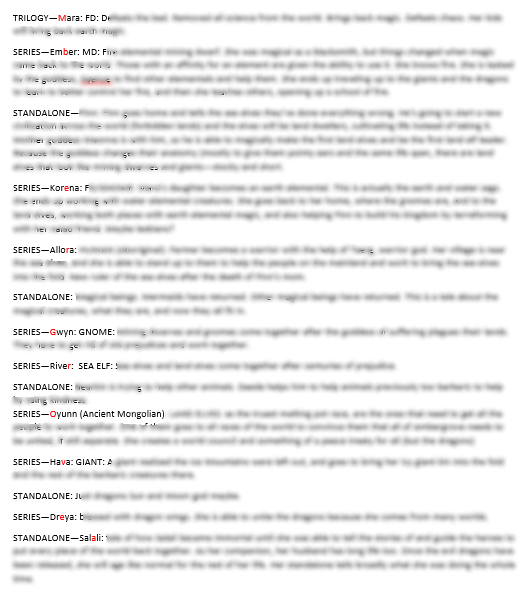
My initial notes (at a pantser level)

To have a “just in case,” I need more than that. Start with one or two sentences for each series.

  • “Mara is forest dwarves and bringing back the magic.”
  • “Ember is mining dwarves and the establishment of the magic.”

Build from that. Include one sentence about each book. What’s the one most important detail from that book? If you aren’t sure how many books will be in the series, skip to just beginning and end. How will that story start in the first book and how will it end in the last book? If you know how you will split it by book, include that. How will this story connect to the other series in the world? What important information can you provide about this series that is relevant if you are unable to complete it?

Start with book outlines in however much detail you’d like to provide, but also include general notes about how the world changes and important elements for the whole. Compile all these notes into one single file, and then save that file as a PDF. Why PDF? Because PDFs are format locked. They are unaffected by changing screen margins, font availability, or other device differences. Why one file? So it’s coherent, cohesive, and doesn’t require any amount of scavenger hunt on your part or on the part of whomever is releasing your “just in case.”

Once you have included all you intend to include and have saved your single PDF, upload it somewhere other than your personal files. Email it to someone, save it to a cloud (and give someone else the download link), upload it to your website and leave it in a draft page so it is not released until the person operating your website chooses to release it. Have it ready.

When “Just in Case” Happens

Have a plan for how to share. Will you plan to share what is incomplete if you are unable to write more? Will you plan to share only in the event of your death? Will you plan to share only with a contracted few, such as another author who may be continuing writing in those stories with your blessing?

Whatever the case may be, have a plan so that you haven’t put everything together for nothing. Print out a copy and have it included in your will how that information should be handled. Have an agreement with someone else for how they will publish an unpublished webpage or share a post or video or other media.

If you are planning for your “just in case” happening while you are still able to release this information, decide at what point you’ve reached that time. Will it be after you’ve gone five years without publishing the next book? Will it be if an accident has left you unable to write? Will it be when you have reached an age that just keeps presenting you with more roadblocks than opportunities? Maybe when you have children or grandchildren or when you reach retirement age by other standards. Decide for yourself when that is.

If you just want to have them together for if someone asks and you do not plan to release all of it, that’s valid as well. Having these notes together allows you to have a compilation of everything you were able to come up with when you were able to come up with it—in case you are unable to fill those gaps organically later on.

That’s all it’s for: just in case you need to have the basic outline of the rest of the series in the event that you are unable to come up with it one day and need to provide it.

The pillars of Ambergrove are documented, and I will soon have the rest documented and an outline page for the website drafted and plans in place in case this brain injury prevails and I am unable to erect all ten pillars.
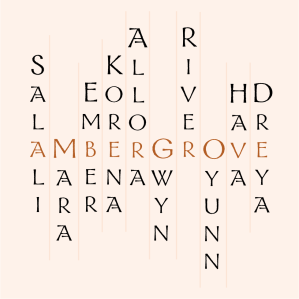
The Ten Pillars of the Main Tale of Ambergrove

Conclusion

This advice blog has a rather narrow topic, but it’s a relevant one for anyone writing series. We want to think that we’ll be able to write and publish everything we’ve planned, but there are sometimes things that get in the way. Once your first story is out there and you have readers, it is your responsibility to those readers to ensure that they are not left without closure if you were unable to complete what you started sharing with them. Just in case.
Authorly Advice 7: Securing Your Work … or Setting It Free

Once our work is out there—or sometimes when we’re working on something to put “out there,” we begin to worry about securing it. There are so many outside threats to a creative work, and there so many situations that cause creators to clutch their proverbial pearls when they really should be embracing said situations. A bit vague, eh? Well, let’s talk about them.

Agent or Publisher Revisions

Let’s start with the first thing writers are likely to run into on their path to becoming authors: professional opinions. Sure, before you get to an agent or publisher, you should have already received editorial feedback and other constructive criticism during the writing process, but the first time you’re likely to encounter a “threat” to the creative work you made is when working with an agent or publisher. Because their opinions about your story come from a different place—the authoritative place of “do this or I won’t represent you” or “do this or I won’t publish your book”—and that can be difficult to navigate.

First, decide what matters to you to retain. Sometimes agents/publishers make suggestions that are actually suggestions, and you can still move forward with that professional without making the changes they recommend. For example, in my short story, “Cross My Heart and Hope to Rise,” which was published in an anthology that released Frida the 13th of June, the publisher requested that I add character names to the story. While that is a valid suggestion, I intentionally left names out of the story to give it a sense of anonymity and to leave those characters open for the reader to fill in names of whomever came to mind. While I was willing to create names if the publisher required it, I began by explaining where I was coming from and advocating for my decision to omit names. The publisher agreed with me after we talked, and the story stayed as written.

However, that is not always the case. I’ve mentioned this countless times in an authorly capacity, but my go-to example for why I chose the indie route for my books is the experience my favorite author, Juliet Marillier, shared in an interview years ago. When she was looking to publish her debut novel, her agent suggested that she make changes so the novel could be marketed as romance over historical fantasy. She added content to the book to make it fit what her agent suggested, and she was later picked up by one of the Big Five publishers. She had a lucrative stretch because of that content change (the agent’s marketing suggestion), though over time it became clearer that she was more comfortable with closed-door, wholesome companionship romance when her later books strayed further and further from that initially published content.

I took her story as a cautionary tale, because I could not imagine making a change like that to my writing. I had changes I was willing to make and changes I wasn’t. Agents and publishers have the power to request big content changes to a work they are representing, and then it comes to the author to decide if those content changes are ones they can live with or ones they can’t. If you care deeply about your content and don’t want to change it, don’t. The right publisher—or the right agent—will come. If you are willing to make the changes an agent or publisher recommends, then it seems you have already found your “right” one. It does not mean there is something wrong with you if you compromise on content, but don’t compromise on content if it breaks you to do so.

Copyright Infringement

Once our work is out there, or once we begin sending it to editors, agents, or publishers, we may begin to worry about the story being stolen. Unfortunately, while we can take precautions to prevent intellectual theft, such as ensuring we only send raw files to trusted sources, putting watermarks on the files, or ensuring the work is clearly timestamped, pirates are going to pirate. Copyright your work, secure the files, and keep records. Some content that may seem to be stolen is coincidental. I heard “wolf dragon” mentioned in Onward just months after my first “dragonwolf” book came out. Those creatures had nothing to do with each other. After building my world and its connection to Earth, I watched The Owl House and saw parallels in how the worlds were connected and what has come ad gone between worlds. When we’ve spent so much time in our stories, we’re going to see them everywhere, even when they aren’t there.

That said, copyright infringement does happen. As an editor, I’ve read so many shameless copies of mainstream works that are barely even off-brand versions of the originals. It is always possible to find infringement. If you do, keeping timestamped records allows you to prove your work is the original, and these records are the foundational materials that will aid you in any battle you may get into.

Adaptations

Certainly most writers since the booms of King, Rowling, and Martin, in particular, have thought about what would happen if their works were adapted for stage or screen. Along with that, we have likely thought about the nightmare that an unfaithful adaptation would be. A movie deal sounds like a great thing, and in most cases it would be. However, we have all seen unfaithful adaptations. I have seen some adaptations that are good in their own right despite the drastic changes made. One that comes to mind is Howl’s Moving Castle. The book is spectacular. The Ghibli film is a masterpiece. Yet, there are colossal differences between the two. Those who haven’t read the book wouldn’t know why Wales is significant to the story. There are significant plot points from the book that were omitted from the movie, but they are both wonderful independent of each other. Unfaithful adaptations would include examples like The Last Airbender movie. Without yucking anyone’s yum, there were fundamental changes like how the bending system works, changes to the pronunciation of character names, and changes to character mannerisms, like having a stoic Sokka. These sorts of changes turned many fans of the original series against the film adaptation.

Sometimes changes are fine, and sometimes they aren’t. We don’t know what kinds of changes someone will make to our work. There are provisions one can make, such as ensuring that any contract includes language about maintaining the integrity of the source material, but there is still a lot of trust given to the screenwriters and directors. While the possibility of an adaptation is a long shot, it’s certainly possible. Don’t get yourself too caught up in the “what if” dream of your own adaptation, but think about provisions you would want to make to ensure an adaptation is true to your story and includes all the details you want to be included—just in case that day ever comes.

AI

In these times, the concern of AI theft of creative work is ever present. There are dozens of AI art programs that use work stolen from artists online without crediting the original work. There are short stories, poems, and even full books that are “written” by AI. It has become so commonplace that publishers and organizations often specify that works that use AI in any capacity will be rejected and readers assume anything imperfect must have been AI. Unfortunately, putting any writing out in the world leaves it open to AI algorithms. Even just typing something out in Word could cause MS Copilot to store your data. Ebooks available through legitimate platforms are still susceptible to AI algorithms. Preventing AI theft is likely impossible. That doesn’t mean your work is for sure going to be copied by an AI algorithm. It just means you cannot prevent it if it were to happen. Steps can be taken in the event of AI theft if your work is copyrighted (the same that would be taken if you experience any other copyright infringement).

I have seen ChatGPT results for user queries that give me pause. Someone I know used it to get tattoo ideas, and when he showed me the breakdown ChatGPT had spit out for him, it looked good. It was organized well and included some buzz words, but there wasn’t anything there that an experienced artist, DM, or D&D player couldn’t come up with—because they have; that’s why that’s in the algorithm. I was concerned initially, and since I am currently in a hiatus because of the brain injury I sustained this year, it had me wondering if anyone would even care if I stopped publishing when AI can just spit out some soulless text that sort of fits. At the end of the day, I write because I love the world I created, and AI can’t take that.

I would argue that AI theft is less of a concern than human theft for the simple reason that AI is often extremely obvious by how awful it is. Sure, over time, there may be more of a concern there, but as long as AI is writing bad stories and generating images with extra appendages, we have some time before we need to worry about it more than any other kind of theft.

Fan Art

Now, for all the unsavory concerns we may have about our work, there are lovely connections too. Fan art is an amazing expression of love for something. While I have rarely seen criticism of fan art, it is out there, so here’s a brief callout: embrace fan art if you have some. Looking at my fan art reminds me just how much my books are loved. Someone used their own creative outlet to draw my characters. How can I not be humbled and awed by that? Encourage fans to create art because that not only shows their love for what you have done but also allows them to exercise their own creativity.

Headcanon

Headcanon is a natural element of fandom. In the books we read, the games we play, and the shows and films we watch, we become bonded to the characters and we imagine scenarios we weren’t explicitly given. If the author hasn’t said something goes one way or the other, the reader is going to have their own ideas about the fates of the characters. Sometimes headcanons can be small things. A nonspoilery headcanon of mine is that the cabbage guy from Avatar the Last Airbender is recognized by Bumi after his other struggles in the show, and Bumi makes him the Omashu official cabbage guy but Flopsy is his constant nemesis. Does that happen in the world of ATLA? Surely not. Am I going to believe it unless something canonical comes out that says something different? Oh, yes.

A reader told me their headcanon for Finn (from the Dragonwolf trilogy) at a festival. Revealing this headcanon would be a spoiler, but suffice it to say that it was something about the character’s handling of trauma that I had not written. I don’t intend to expand on that element at all, even though I will return to the character in future books, so I told the reader that their idea was interesting and that those choices made sense for Finn—because they do.

Headcanons are not harmful. If you are meeting a reader and their headcanon doesn’t match what you have planned for the character, whether or not you intend to publish those plans, don’t quash theirs. We like to think the characters we love or hate meet good or bad ends, and it’s a small thing to allow us those thoughts.

Fan Fiction

Fan fiction has always been a contested medium. I’ll be the first to confess that I have always thought of it as lesser—something done by children who just want to write themselves into the world. I have since learned that it is actually its own rich genre. Sure, there’s a lot of smut in there, but there’s also a big audience for that. Sure, a lot of it is self-insert writing, but what’s wrong with that?

Fan fiction is not another author taking your work and making money off of your ideas by creating new, competing stories. It’s an expression of someone who just cannot get enough of the world you have created. They need more. They need to know about little characters you only mention once. They need to imagine themselves in the world because they love it so dearly. They need to know what happens to the characters after the story. Sometimes we need to work things out for ourselves by writing them down. Writing can be therapeutic in many ways. I am writing fan fiction right now at a doctor’s recommendation, because it’s low-stakes writing that can work the parts of my brain that were damaged by my injury. Kids who start out writing fan fiction can become masterful adult authors.

At face value, someone copying your work is plagiarism, but fan fiction lives in a realm outside of that. Like fan art, it’s creation that is a fan’s expression of love for your work in a way that also exercises the fan’s own creativity. Fan fiction is pure human creativity.

TTRPG PCs, NPCs, and Campaigns

This mode of fan creation doesn’t apply to all stories, obviously, but it applies to more than we may think. There are instances like mine, where I have created a D&D core book and foundational system that’s made for players to use as a guide and make their own. RPGs (role-playing games) are all about making it your own. In the core book, I explain elements like how there should only be one Ranger at a time and that the Ranger should have forest dwarven blood. There should only be one Bard at a time. However, if someone wants to do a party of all bards, they totally can. It’s their game. If they want to take established characters and use them in their games, they totally can. If the characters don’t act like they do in the books, that’s okay.

I run a one shot at festivals that uses characters from Ranger’s Odyssey, and players have almost never played the characters as they actually are. And that’s okay. Because it’s a game inspired by the characters and the world and not a canonical story. I run an Ambergrovian campaign with my own group, and when my players were creating characters, they picked a time period when there is an established Ranger, an established Bard, and an established firebrand Elementalist—but three players picked those three classes. Now, I’m the author. I’m faced with running a TTRPG that scraps much of what I have established in the main story of my world, and it would be natural to fight that. However, this is a game within the world. As soon as the first player asked if he could be a Bard, I decided I would make our campaign an AU (alternate universe). In this universe, we have Teakroot instead of Salali. We have Varin instead of Mara. We have Lycastus instead of Ember. There are a few characters that overlap. The players will meet Lir, the crew of Hrossdraugr, and the villagers in Nimeda. Characters are still there, and it’s a rich, fun, character-driven adventure. If I leashed the players and packed them into the bounds of the novels, why even play?

Outside of full systems like mine, there’s also the potential for players or DMs (Dungeon Masters) to use known characters in their games, either directly or by description. I once created a female dwarven barbarian named Gimlia (Gimli, Lord of the Rings). I played a Baldur’s Gate 3 game as a dragonborn Oath of the Ancients Oathbreaker paladin that was intended to follow the storyline and choices of Draco from Dragonheart, and my Dream Guardian was designed to look like Bowen. It was a fun time. I’ve had a DM walk my party through a one shot clearly inspired by the Atlantis cartoon. It was awesome.

At the end of the day, RPGs are meant to be whatever the players make them, and use of established characters or stories in an RPG is a harmless expression of love.

Other Homages

An homage is just that: a respectful nod to a work you appreciate. As long as creators aren’t presenting your characters as theirs, let them have it. Cosplay is fantastic, and cosplayers often take liberties with the characters in their design, such as genderbending or color changes or the addition or removal of scars. Cosplayers are often not the body type of the character they portray. I went to Indy Comic Con years ago dressed as Jayne from Firefly. I had the Jayne hat, a Blue Sun shirt, boots, and utility pants, but I was an overweight woman with long hair. There were still people who saw me and said, “Oh! Jayne!” because I had recognizable elements of that character. It was an expression of love for the show in a setting that was all about expressing love for characters. Homages are everywhere, and they’re nothing to be concerned about.

Conclusion

There are so many different ways for a written work to be taken and changed. Some of these are welcome; some are not. At the end of the day, be mindful of the specific situation and only hold onto your work if it’s a situation that calls for it—certain professional situations, copyright infringement situations—and let your work go and be what your fans make it in other situations. Don’t be threatened by homages. It’s an honor to have someone love your work so much they want to draw them, make up their own stories about them, or play them in an RPG. Once your work is out there, it’s out there to be judged, it’s out there to be potentially stolen, but it’s also out there to be loved.

Authorly Advice 6: Writer’s Block to Writer’s Wheel

May’s authorly advice comes from my experiences but also, by extension, comes from one of my neurology specialists I’ve been seeing for my brain injury this year.

Anyone who has written has dealt with writer’s block in on form or another. We’ve spent hours or days just looking at a blank page or getting caught in the cycle of typing and deleting the same text a dozen times. We have our own strategies for pushing forward despite the overwhelming blankness, but what we don’t often have is someone telling us to stop.

Writer’s block, whatever its cause, is always seen as a hurdle to hop over, rather than a a bump in the turning wheel of writing. There are three stages of writer’s block/dealing with writing, and these are not progressive stages—they are part of a circle.

If driven by an extrinsic deadline, it certainly makes sense to push through. However, when we push to just write something, we often end up writing things that are below our usual standard. My advice in this instances has always been to leave notes and carry on. That’s the first step here.

Keep Calm and Carry On

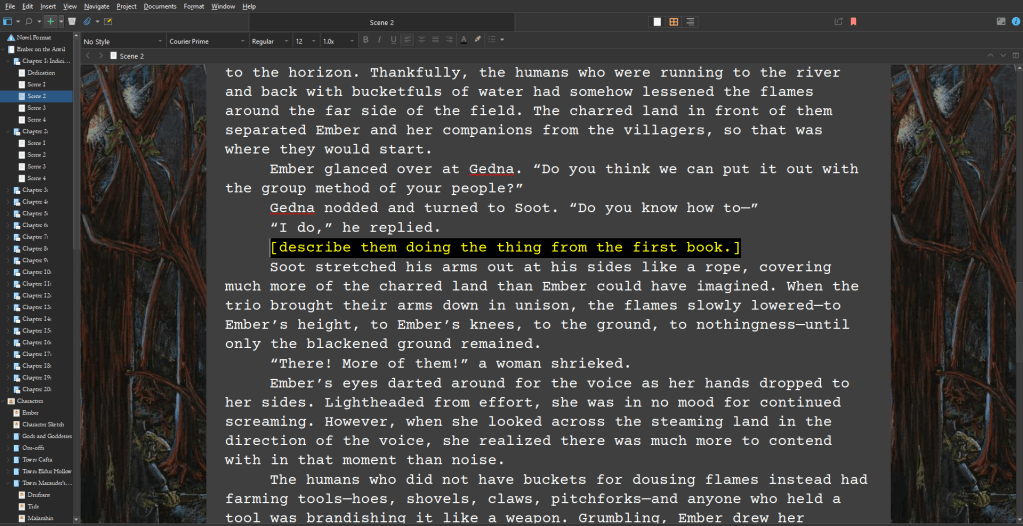
[write here about bracketed notes—yes, I left this on purpose]

In instances when you don’t know the next thing you want to write but do know the thing after that, bracketed notes are the best bandaid for writer’s block. If, for whatever reason, you have to just push on, bracketed notes will carry you forward.

I always push this, but that’s because it helps so much. Sometimes you just have to make it work and keep going, but that doesn’t mean you will magically know what to write. If you just write garbage so there’s something written, sure, you’ll have something to edit, but you’ll also put in more work that will later need to be undone. If you put a note in, [here I’ll talk about monkeys or something], you have an idea what that scene will be, but you don’t have to slow your momentum to think of it or look it up in prior works (as below) nor stare at a blank page. You can always go back later to add whatever you skipped, but if you allow that thing to prevent you from moving forward, it can hold you back indefinitely. Sometimes leaving a note for yourself so you know to come back and just moving forward can help you to come up with later details that can fill in the earlier gaps. Sometimes, but not always.

From Ember on the Anvil, which is currently paused for my recovery.

For many of us, if we don’t just stop and get stuck, this phase of pushing on is still where we stay, stubbornly refusing to step back—because we feel we can’t or because we feel we shouldn’t—and we forget or don’t realize there are two other valuable options.

Just Stop, Take a Break, and Regroup

Sometimes, the best thing you can do is just stop. When your brain cannot come up with the next thing to write, you may be experiencing burnout. Burnout is the body telling us to stop. I’ve talked a bit about this in another blog. Whether you pride yourself as a “mind over matter” person or you just cannot afford to take the break your body needs, burnout is your body begging you for a break.

In my case, right now, my brain is having difficulty coming up with the things I want to write because it is physically injured. I have spent nearly five months focusing on recovery and on giving my brain that break. I had deadlines and goals, but it does no good to push for the deadline if your writer’s block means that you’re presenting a garbled mess or you push yourself too far altogether. You can do too much.

At the end of the day, you are a human being who needs breaks. Take one. Go to a place you love, spend time with family or pets, get back to nature, watch a show or play a game, read a book, or even just take a nap.

I read a few books, meditated, rewatched Cold Case (one of my favorite shows), and later played Baldur’s Gate 3 for the fourteenth (?) time.

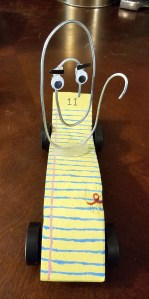
After giving myself a break, I did have a burst of creativity (before I immediately overdid it and set back my recovery). I was able to create a Clippy Pine Derby car for work. I was able to create a one shot set in the Age of Magic and lay the groundwork for an Ambergrovian campaign—including, most recently, beginning to create an Ambergrove Compendium in Foundry Virtual Tabletop (putting the Ambergrovian Adventurer’s Guide into the program for running D&D games in this world). I attended events and ran games. I completed a few rounds of editing. I took on greater tasks at work. All it took was some time not trying do do something creative and I was able to scratch that itch again in no time.

Redirect, and the Writing Will Come

And yet, for one reason or another, sometimes the best thing isn’t to push through or stop altogether but to redirect. When I was laid off last year, it was really difficult for me to come up with creative writing when I was so consumed with worry about the future. Writing a book and working in the world I created was just too overwhelming, so I slowed down an redirected. That was when I started writing short fiction for anthology submission calls. What I wrote then was on a smaller scale. There were lower stakes. Most of the stories were limited at a few hundred or a few thousand words, maximum, so there wasn’t room to get lost in the weeds. It was through this writing of short fiction that I was selected for publication in an anthology that releases in a few weeks.

Though this mode of combating writer’s block had been helpful last year, when I hit my head, I didn’t think of using it. First, I tried to push through. After a thorough scolding from a handful of doctors, I then took a break. After a restless few months, temporary recovery before collapse, and then a bit of despair, one of those doctors recommended a redirection.

Pushing through caused harm, and taking a break caused harm because I’d been so restless that I’d immediately undone the positive effects of that break. However, if I were to keep going—just slowly—then the bite-sized pieces would prevent a backslide just as they had allowed me to ease back into working creatively before. Because of the state of my brain, rather than getting back into creating short fiction from scratch, the recommendation was a bit unorthodox: fan fiction.

Now, I wrote fan fiction when I was a teen. Many writers did; that’s where a lot of us start. Writing a story where the characters are created, the world is created, and the character interactions within that world are largely created lowers the stakes greatly and allows the writer to supplement their own creativity with someone else’s. Fanfics are not typically seen outside of circles wherein they are appreciated like AO3, or in my teen years, Mibba.

Fanfics are often seen as low-hanging fruit, and they are, but they are also gateway stories. If my brain was just going to continue to attack the low-hanging fruit (the description given by the neurologist for how my self-doubt has flared up with a vengeance), the least I could do was pick more of that fruit to replenish myself. Writing is writing, and as long as you don’t plagiarize in future works outside the fanfiction genre, fanfiction writing is a healthy redirection that can allow you to continue to work that creative part of your brain without strings or fears.

So I plotted a fifteen-chapter Baldur’s Gate 3 fan fiction, did some “research” in a couple Origin playthroughs, and began writing. After months of writing very little, I have written a whole chapter. Does it follow the game events that were already established? Yes. But it’s also written in my style. The tone matches my connection to the characters, and the internal dialogue and story trajectory matches how I feel about their development. I am excited to write it. I am happy just sitting and writing, which hasn’t been the case in years. I have enjoyed it, of course, but when writing original work in Ambergrove, the more I write, the greater the weight is on my shoulders—concerns about continuity, Imposter Syndrome, and the knowledge that Ambergrove is my world and anything I do reflects upon that world.

Historically, once I “grew out of it,” I have had very little respect for fan fiction, viewing it as childish self-insert writing alone (as it was for me when I wrote it), but just because that’s all it was for me does not mean that’s all it can be. There’s no Imposter Syndrome here—because I know that I am not one of the professional writers, and I am not trying to be one. That is, except for when an image of me with a comically large mustache in the Larian writers’ room crosses my mind.

Listen to Yourself

As I’m sure is clear from the often rambling nature of my blogs the past few months, I am still struggling quite a lot during this healing process. My wordfinding and memory skills have suffered lasting damage, and I have been trying for months to get back to where I was intellectually and creatively. Sometimes the best thing for us is to push on, sometimes that’s to stop and take a break, sometimes that’s to redirect and try something new, small, or long forgotten. Whatever the case may be—one or all—the key is to listen to yourself. If you don’t think you can push on but are going to anyway, listen to yourself and stop. If stopping is driving you crazy, try redirecting to short fiction, world building, fanfiction, or even non-literary creative pursuits like painting or cosplay. If redirecting makes you feel a powerful drive to return to your work in earnest, try pushing forward with it once more.

At the end of the day, although our writing can often take over much of our own worlds, it flits into the worlds of others. The pressure we impose on ourselves to push on only really comes from us. If we look at writing as a wheel and at the act of writing as a threefold cycle, we eliminate some of that imposed pressure, broaden our options, and allay some of our fears and self-imposed pressures.

As long as a wheel exists, it can keep turning. The speed in which it turns doesn’t add or subtract value. As long as you’re moving, you’re trying to turn that wheel just a little, you’re going everything you should be.

As we near the midpoint of 2025, I am sure that, like me, there are other writers looking back incredulously at the half-past year and wondering whether they’ve done anything worthwhile.

You have.

Keep at it. Dial back the pressure you impose on yourself, turn the wheel a little, and try the next thing.

Authorly Advice 5: Events

For many authors, the only real way to get our books out is by attending events. Events look different for writers of every genre. In this blog, I’ll go over a few different types of events and what to expect from them, tools for smooth events, some no-nos of events, and some tips for getting into events and prepping for them.

Types of Events

Author Fairs/Book Fairs (Multiple Authors, Same or Multiple Genres)

These events are typically free to attend or are very affordably priced (usually no more than $25). Reach out to your local libraries and independent bookstores for their particular application processes. An event like this will likely have 10-30 other authors all set up at tables around the building. You have your own space and are usually provided a table and one or two chairs. You’ll arrive about an hour before the event starts, setup your table, and have the chance to talk with other authors around you. Take that opportunity. Talking with other authors is a great way to learn more about other writing and publishing methods, event practices, other events, and cool books you may not otherwise have heard about. A lot of these events also include panels or individual talks. The author is expected to handle all sales at the table.

I also do “tradesies” at most of these sorts of events. If I am interested in another author’s book(s) and they are interested in mine, we will trade book for book or series for series.

At the end of the event, you can typically choose to leave copies of your books for the shelves—either a copy for library circulation or a few copies for store availability. Most bookstores will carry on consignment: you give them the books and they sell them for you, keeping a cut. This is the lowest risk for stores. Some will do wholesale, wherein they will buy the books from you at an agreed-upon price, and then they retain all profit from the sale. ALWAYS go for library availability. Libraries are not your enemy; what you lose in sales will be minimal compared to the goodwill and the readership you will gain.

Some I have attended:

  • Enchanted Novelties (Harrison, Ohio, bookstore): Childrens and YA Book Fair
  • Lawrenceburg Public Library District (Lawrenceburg, Indiana): Author Fair
  • Monrovia Public Library (Monrovia or Martinsville, Indiana): Author Fair
Lawrenceburg Author Fair, 2025

Bookstore/Library Readings, Workshops, Releases (Individual)

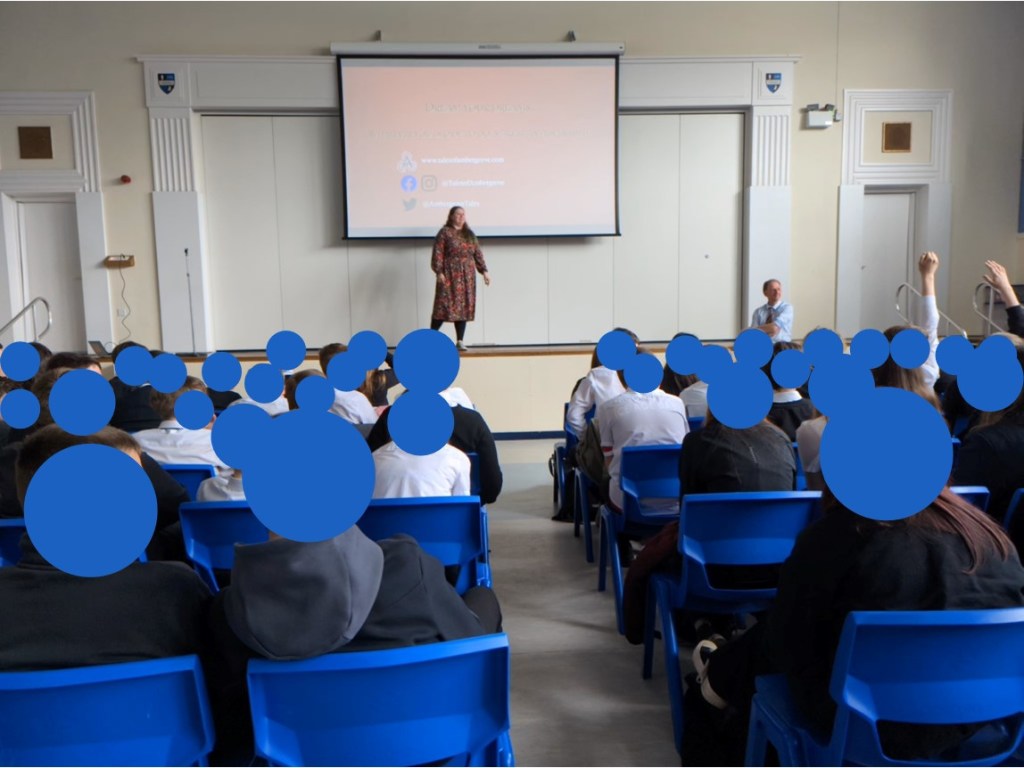
These are typically solicited events. They require authors or agents to reach out to see if the location is interested in doing an event. In some cases, prior events can lead to individual events (attending the author fair at Monrovia’s library prompted the organizer to reach out about workshops and the summer reading program two years in a row). Either way, these events are set up on a case-by-case basis. I just had the new book for the book release, and the bookstore advertised. I just made a PowerPoint for the school presentation, and the teachers and school librarian organized everything; I didn’t bring any books except a couple copies to show the students during the presentation. Monrovia’s librarian had the idea that I do some workshops, and after we’d decided on subject matter together, I created the whole workshop. In any case, an individual event requires more attention, dedication, and involvement in creation, preparation, and execution.

Build solid relationships in the group events you attend. Besides being professional and recommended simply for goodness’ sake, those relationships open doors for individual events. Returning somewhere for an individual event draws in return readers.

Develop a professional pitch for bookstores, libraries, and schools (if applicable) to see if they are interested in hosting an individual event. Tell them what books you have, what experience you have with events, how successful your books are (however you measure that success), and what you could provide for an individual event. Be prepared to put some money into preparing materials or purchasing stock—whatever the organizer asks that you are willing to provide. Otherwise, there shouldn’t be any upfront costs or registration fees of any kind.

Some I have attended:

  • Morgenstern’s Bookstore (Bloomington, Indiana): Book Release (Wheel of Fate)
  • Orb’s Bookshop (Huntly, Aberdeenshire, Scotland): Reading, Q&A
  • Webster’s High School (Kirriemuir, Angus, Scotland): Presentation, Q&A
  • Monrovia Public Library (Monrovia, Indiana): Workshops, Summer Reading Events
Webster’s High School, 2023

Genre-based Events, Community Events (Renaissance Faires, Conventions, Fall Festivals, County Fairs)

The heavy-hitter events are going to be your fairs and conventions. While these come with a lot of reach in readership and often a lot of profit, there’s also a lot of upfront costs. Libraries, schools, and bookstores often provide most of what you need and don’t charge for it. Conventions and fairs require authors to register as vendors and pay a booth fee, and fairs often require their vendors to provide tables, chairs, and a tent in addition to their other materials. Depending on the size and popularity of the event, registration can be anywhere from $75 to $300, $1000, and up for a single weekend or a full run (4-8 weekends).

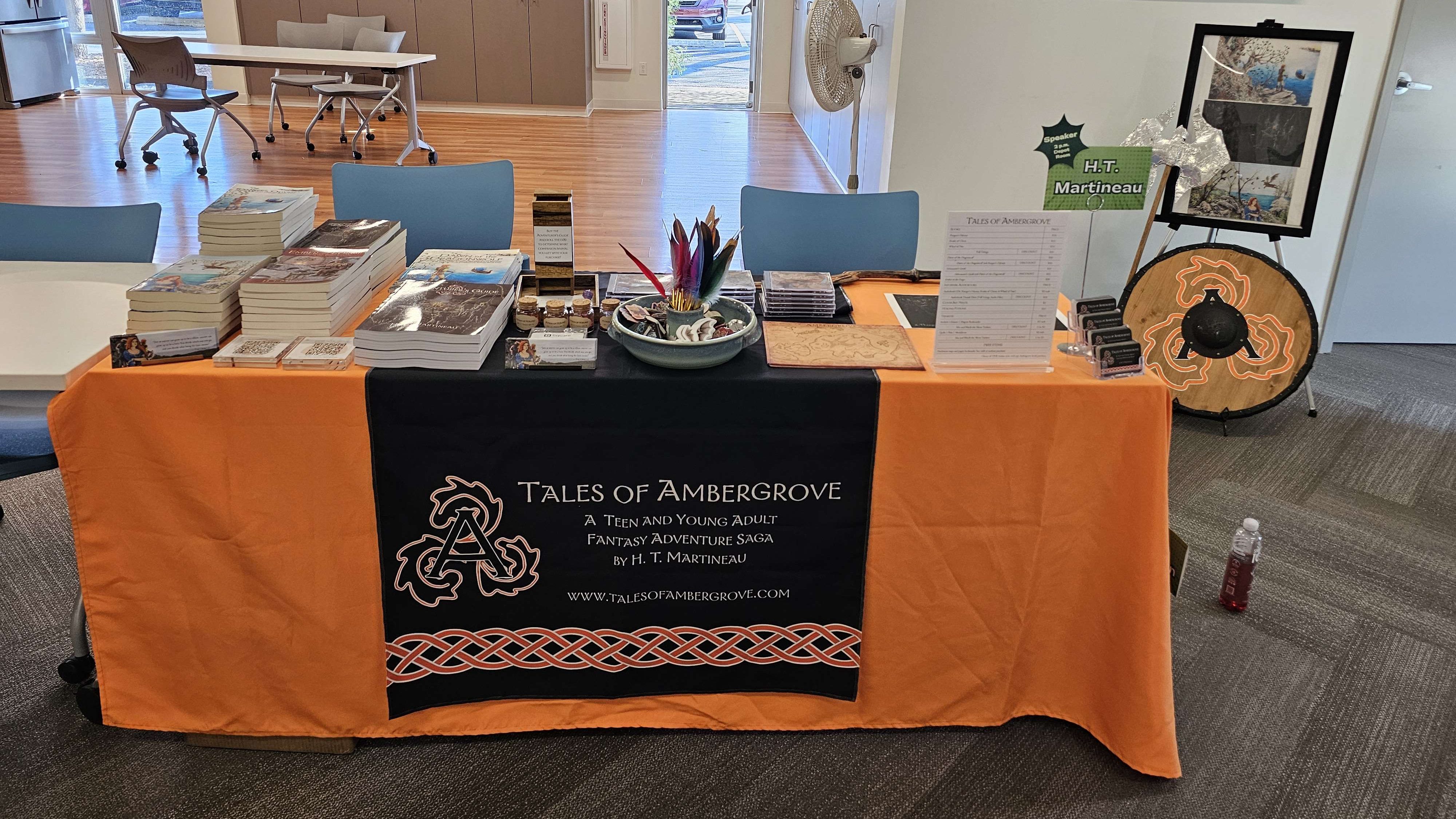
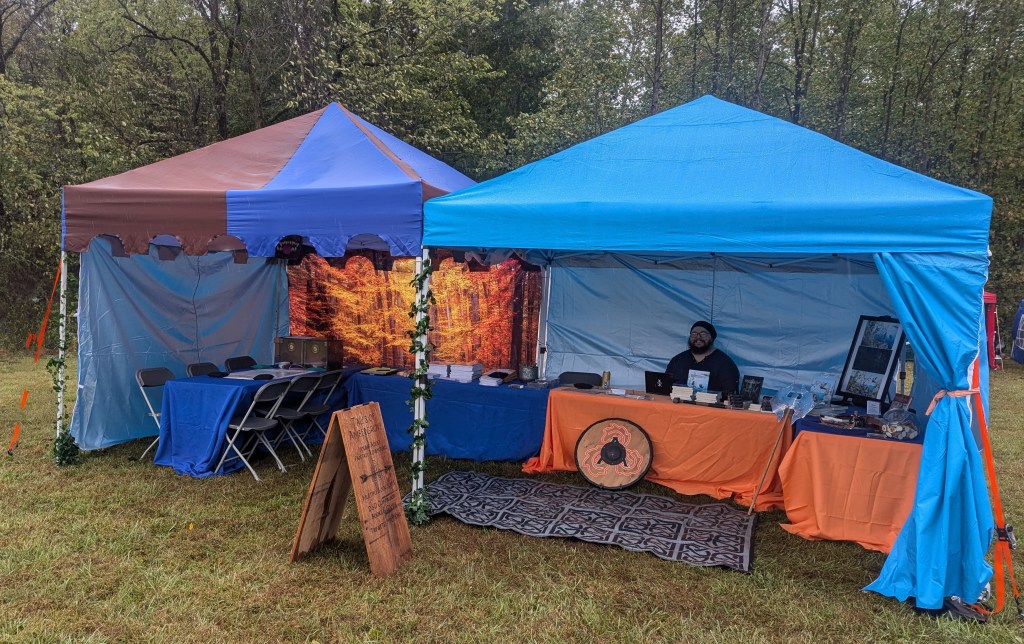
It’s important to plan many months ahead for these types of events, sometimes even over a year. GenCon registration is 13 months before the event. Many fall events have registration ending in January. Competition for these events is fierce, so when preparing to apply, you’ll need to have as many materials for your booth as possible—multiple books, maybe pins or stickers, related items (healing potions for me). If you can offer something else, include that. I run a D&D one shot at my booth. Getting accepted to an event like this is the first hurdle. The second hurdle is paying for the event. I typically make back over double what I spent for the events when I do these types of fairs, but I have to be sure to have the money to purchase bulk book stock (usually at least 50 copies of each book) as well as money for the registration fees and any other supplies—tables, chairs, pop-up tents, the canopy covers (left tent in the image below).

While simply looking into events you already know of and are interested in ensures that you can apply for at least a few events, not all are widely listed. Conventions may have their own database, but there’s at least one convention in every state. Often, there are multiples. Fairs and festivals are almost all catalogued here, in a database that lists each chronologically by state. I’ve discovered dozens of events by looking through and recording the ones I wanted to apply to in the future. Look through the listings for each state you’re willing to travel to, and then look up each event that piques your interest. Most specify who to contact for application/registration, when the window opens, and what the booth fees are. Many of these can be consistent readership builders, as once you’re in for the first year it’s easier to get back in for future years.

Some I have attended:

  • Clayshire Castle Medieval Faire (Bowling Green, Indiana): regular beginning in 2024
  • Indiana Enchanted Fairy Festival (Bowling Green, Indiana): coming 2025
  • Ohio Renaissance Festival (Harveysburg, Ohio): Fantasy Weekend, Viking Weekend, Tricks and Treats Weekend; 2021-2023.
  • Southern Indiana Renaissance Faire (Seymour, Indiana): Celtic Weekend, Fantasy Weekend 2025 (coming soon)
Clayshire Castle Medieval Faire, 2024

Taboos

Authors can be desperate to make sales at events—to cover costs, break even, or ensure profit goals. This can sometimes result in taboo behavior. The first thing to remember at an author fair or book fair is that all the other authors have similar goals and challenges to yours. These events are not meant to be cutthroat me-before-you events. If someone is talking to readers at their table, even if your books are similar and you see an “in” immediately, don’t insert yourself when another author is talking to potential readers. At an event this year, I saw another author grab business cards and interrupt reader conversations with other authors to give out business cards and draw people over to their table. That author sold the least amount of books of the handful in the same room and many of the author’s business cards were in the trash when we were leaving. Because that kind of pushiness is a no-no. Yes, we want our information in readers’ hands, but if you make someone feel obligated to take your information, on the spot, they’re not likely to want anything to do with it. If you interrupt other authors and take time with readers from them, you are souring yourself toward others in the industry who may have otherwise wanted to help you. I sat next to an author at my last event who was kind to me and remembered me from the previous year. Her books are fantastic, and I ushered people to her. She ushered people to me. We talked shop. Events are fantastic for forming bonds with other authors if you conduct yourself respectfully.

Don’t bad-mouth other authors or the event while you’re at the event. Talking disparagingly about someone who was late or whose booth isn’t what you expected, complaining about table size or location, or openly talking about whether you made enough money at the event is poor form. Attendees notice those things. Organizers notice those things. Having a poor attitude may get you booted from the event next time or sour you to other authors or vendors who may otherwise want to help you.

Show attendees that you want to be there—and be professional. Lounging back in a chair and messing around on your phone shows that you aren’t interested in communicating with attendees. They’re less likely to come to your booth and ask you questions if they feel like they are bothering you by doing so. At my last event, we were given lunch, and the authors at many tables were openly eating. I had my food on the box behind my table and was taking single bites and remaining outwardly attentive. Two attendees skipped other tables and came to mine, telling me verbatim, “Everyone else seems to be having lunch, so I didn’t want to bother them.” Those attendees didn’t come back around to check out the tables they missed, but they did get information from me. One bought a book. Strive to be friendly and approachable. You can update your author socials at the start of the event, but otherwise, stay off your phone and appear attentive from start to finish.

Overall, just be kind, be present, and be professional from the moment you arrive to the moment you leave.

Tools and Tips

Make sure you have a reliable card-taking method. Sometimes people bring cash to events, but not always. We’re in an age when card is king. Square is free. So is PayPal. Give readers a few options and make sure you understand the system you’re using. I use Square and have it on my iPad with data—so it isn’t reliant on WiFi at the event being available. I purchased the chip reader for Square for ease of transactions. Some authors choose to have everything listed online and provide scannable QR codes for online purchases. Be sure to also have a way to take cash. Older readers may not want to/be able to scan a code and do it all on their phone. Your cashbox should have $50-$100 of smaller bills in it at the start of the event. I typically take out $100 ($20 in 1s, $40 in 5s, $40 in 10s). That has historically been enough to ensure there’s change when readers pay with twenties. I don’t take larger bills.

Table Staples:

  • A colorful tablecloth: pick a color that goes with your books, either that fits the theme somehow or matches the covers. I chose orange for mine because the series logo is orange.
  • Printed price signage: print off prices and any discounts you run and display those in picture frames, 8×10 standees, or blocks to keep the paper professional and ensure prices are displayed and legible.
  • Always have something free: I have parchment maps and bookmarks free without purchase. The bookmarks look nice and include all my info. The maps are interesting and may garner further interest in the world. If you provide free options, readers are more likely to take your information and purchase later (or read from the library).
  • Invest in a table runner or other professional signage for your table.
  • Bags: get paper bags or plastic bags for your books and give readers the option. I have larger plastic bags for most events and paper bags for specific other events. I’ve printed labels with my information and put them on the paper bags.
  • A collapsible cart: I got a folding wagon a couple years ago, and that thing is my best friend. I can park far out, load everything into the wagon, and easily walk wherever. Once I’m set up, I can break down the wagon and slide it under a table until I need to load it back up.
  • Plastic tubs: I have collapsible plastic tubs, though they’ve never been collapsed. Measure your books to ensure you can fit at least two wide in the tub and stack your other materials in there with the books. If you’re publishing Amazon Direct, don’t have a visible Amazon box. Use an unmarked cardboard box or a plastic tub.

For Outside Events:

  • Put some thought into your canopy tent. Setting up a canopy can be the most frustrating part of this process. I’ve been using pop-ups for years, and my favorites are Crown Royals with sidewalls. They’re sturdy and easy to set up. The ones I have now are extremely user-friendly models, and we can have the tents up or down in under 10 minutes.
  • Have a plan for setup and teardown that works in the rain as well as the sun. Most places require vendors to wait until the moment the event closes or until after the last patron leaves to start packing the booth. If you make sure you have an efficient plan, you can be packed and ready to go quickly (and without standing in the rain or in the dark as much.
  • Always have: a flashlight (a real one, not a phone light), scissors, tape, bungee cords, binder clips/safety pins, bags for trash, paper towels, small snacks like granola bars (even if you plan to go get food at a booth), water or Gatorade, ratchet straps (for better securing the canopy if wind is expected), twine or other string (you’d be surprised what may be solved with some string), a notepad, permanent markers, and something else to take notes with.

General:

  • Pack your boxes in reverse order. Your tablecloth and runner should be at the top of one of your boxes, so you can take them out first and pile other things on top. Next down should be any receptacles, like book stands or card holders. When you repack, you’ll also do books and items, receptacles, tablecloth, so when you are ready to set up the next time, you can start with the tablecloth again.
  • Have any card reader and device out separate to be charged the night before. In case of battery issues, also have a charged powerbank of some kind to use if needed.
  • Print any directions from the event coordinator to ensure you have a physical copy if you don’t have cell service or have any other issues when you arrive.

I’m certain there’s things I’m forgetting and things I’ll learn in future events. Always be willing to share what you learn. There’s no reason to gatekeep here. Best of luck at your coming events!

Authorly Advice 4: Blurbs, Keynotes, and Keywords

This March advice comes in part from a workshop I held back in 2023. Today, I’ll be talking about writing the author blurb and the back cover blurb, creating a keynote, and selecting keywords.

Author Blurb

Provide targeted information about yourself. The About the Author gives you the chance to introduce yourself to your readers and typically includes these main elements: education, current career, other publications, family information, and regional interest (e.g., city and state of residence).
Include relevant information. Have you been published before? Have a degree related to your subject matter or to writing? Think about what makes YOU the qualified person to write this story.
Include interesting information. Readers like knowing some personal info about authors. Things like hobbies, pets, and family. Many authors also include education and general location.
Keep it simple. In most cases, the book is what sells, not the author. Be sure to keep it short and sweet and include more information about your book than you do about yourself. The author blurb for the cover or back flap is typically about 50 words in length.
Write in third person. Don’t use “I” in your author information. Write like you are talking about someone other than yourself.
What about an author biography? If you have many accolades or additional information about yourself you would like to include, do it! Just not on the cover. Keep the cover text short, and include a full author biography in the back matter. These are usually a full page or two. I have an extended author biography on my website that just has more information about my interests and how those contributed to my books.
What about a photo? When selecting an author photo, you have two basic options. First, you could go to a professional photographer and have a professional author photo taken. An experienced photographer should be able to assist you in creating a photo that serves you well. I go to Icarus Photography in Bloomington for my cover art photography, and I highly recommend her for any photography needs. Second, you could include a photo that fits the subject matter of your book. My author photo is a nonstandard photo. I don’t want to have my face in it for various reasons, but I compiled/made a costume that aligns with my book.
What if I don’t want to include _? Great! You don’t have to. Readers are not owed information about you. You can come up with a fictitious blurb for a pen name or keep it vague or even blank. I am careful about what information I include. Only include what you want to.

Book Blurb: Fiction

Include details such as plot, setting, main characters, and some of the conflicts those characters face. You should reveal enough about the general outline of your story to draw readers in without giving away any crucial surprises that may appear in your plot.
Who are the main characters? What are they like? Think main characters, not a bunch of background people. You don’t want to have too many names in marketing copy, so think 2–3. Character names and basic descriptions are imperative to writing interesting blurbs. Don’t try so hard to be vague that we don’t even know who the main character is.
Where is the story set and what time period? Also, is the setting relevant to the story? If so, tell the reader why.
What is the main conflict? Conflict is what makes a book interesting and drives the story. Consider what the main characters wants/needs and what or who is keeping the character from that goal. Include the main conflict in your blurb.
Do not be vague or obscure. This is not an abstract concept of your book or a personal opinion of its quality. Your blurb needs to be a detailed account of who/what/where/when. Be sure to include at least two significant plot points that do not give away your ending.
More is better. You’ve heard the adage “less is more.” That is not true in the blurb for your readers. Make sure you include enough information about your story to set it apart from others of the same genre—don’t try so hard not to give things away that you give away nothing that wouldn’t also describe a thousand other romances, adventures, thrillers, or what have you. As long as you don’t give away the ending—or a twisty-twist!—you’re probably not giving too much.
Tensing should progress to draw interest. The blurb should progress from present to future tense as we build toward the omitted end. It’s “here’s what the characters are doing, but will they be able to do _ or will the story end in tragedy? Read more to find out what happens next!” Even if the entire book is written in past tense—as is standard for fiction—the cover text is always progressive from present to future to garner interest in what’s next.
Blurbs are typically divided into two to three paragraphs and a keynote. Your first paragraph introduces your main character and the necessary background, time, and setting information. Your second paragraph introduces the conflict and at least one of the big plot points. Your third paragraph wraps up the information and raises a question as to later elements of the story. A final sentence (keynote) summarizes the main storyline in one punchy end. This is sometimes combined into the third paragraph and a separate keynote is created for marketing materials instead of combining them into one. An endorsement (if included) would be before or after the full blurb.
Your book blurb should always be longer than your author blurb. The typical book blurb is about 150–250 words in length. In contrast, your author blurb should be about 50 words. Even if your name can sell your book on its own, it shouldn’t. Include a small serving about yourself and a healthy helping about the book.

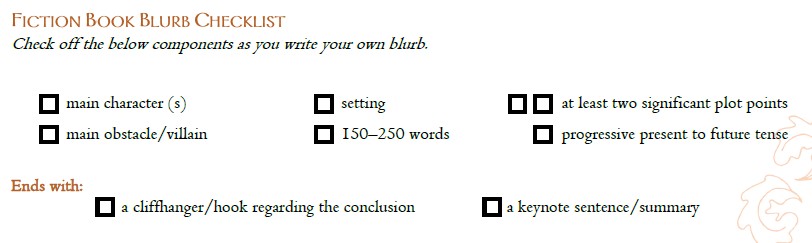
Fiction Book Blurb Checklist:

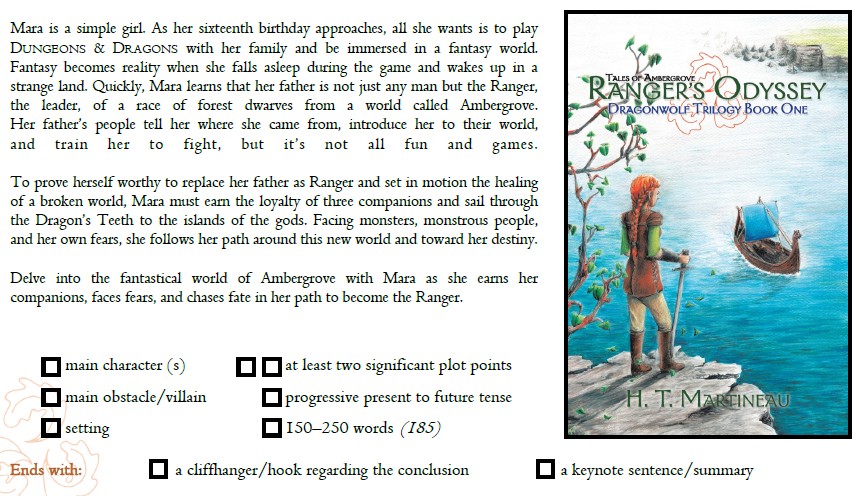
Fiction Example

Book Blurb: Nonfiction

Include details such as general information about the major points or purpose of the book. Your text should state what your book is about, how it’s unique, and what a potential reader might gain from the book.
What is the point of your book? What do you want the reader to gain from it? Is your book meant to be a resource? If so, how? What tools does your book have that would benefit the reader? What view does your account provide? Simply, why should a reader buy it?
Do not be vague or obscure. Provide details about main points discussed in your book, either in the form of a bulleted list or a few examples structured in a paragraph.
Why did you write it? How is it unique? Nonfiction works typically have a drive behind them. Are you writing a memoir to share your story to help others? A biography to share the legacy of someone great? A cookbook because you love your grandmother’s recipes and know others will too? A new teaching tool for others in your field or a revolutionary guide for clients? What sets it apart from other books on the same topic?
More is better. You’ve heard the adage “less is more.” That is not true in the blurb for your readers. Make sure you include enough information about your book to set it apart from others of the same genre—don’t try so hard not to give things away that you give away nothing that wouldn’t also describe a thousand other cookbooks, biographies, health books, or what have you. Give as much about important broad topics as you can fit into the recommended length.
Tensing should progress to draw interest. In fiction, the blurb should progress from present to future tense as we build toward the omitted end. In nonfiction, the blurb is typically factual and thus in present text (“the book has this and this and this”). However, there is also an element of future tense if the reader is meant to learn or do something. “Unlock your own future in The Future of the Past” or “In this book, learn how to face your fears and cook something even your mother-in-law will love!”
Blurbs are typically divided into two to three sections and a keynote. Your first section/paragraph introduces your book and the “what” and “why” of it. Your second paragraph lists or summarizes some important details. Your third section leads into your call-to-action. A final sentence (keynote) summarizes the general matter of your book while also calling the reader to use what’s within. This is sometimes in the third section and a separate keynote is created for marketing materials instead of combining them into one. An endorsement (if included) would be before or after the full blurb.
Your book blurb should always be longer than your author blurb. The typical book blurb is about 150–250 words in length. In contrast, your author blurb should be about 50 words. Nonfiction books should have information about you to show why you are qualified to share what you know, but the contents should sell the book in addition to your name.

Nonfiction Book Blurb Checklist:

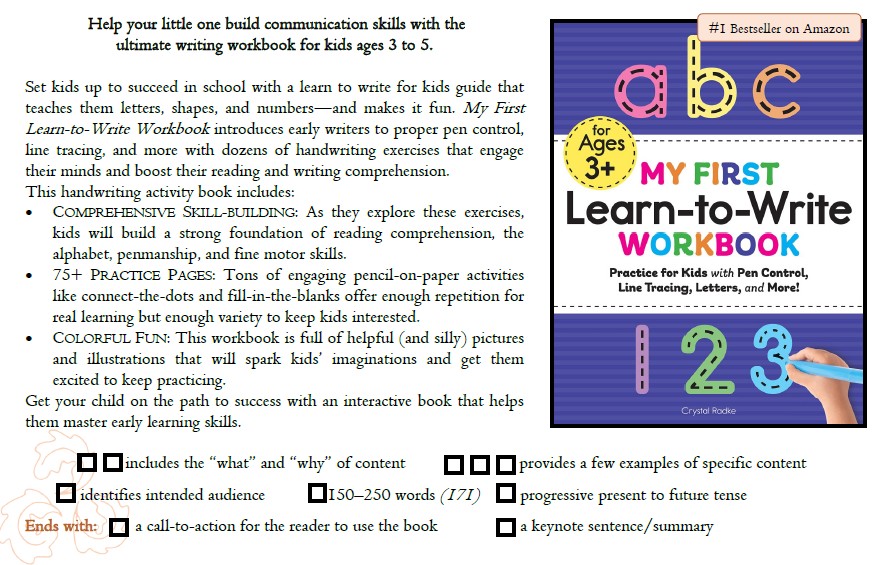
Nonfiction Example

(pulled from the internet; no affiliation to Tales of Ambergrove)

The Book Blurb: A Trailer for Your Book

Think of your book like a movie. To get viewers to go see a movie, production companies release trailers to tell the potential viewer a little about the movie and to grab their interest. The turn of the century trailers (the ones that still had narration) were the best examples of this as they relate to cover text, and my favorite is Hidalgo (2004).

Loose Transcription of Trailer

Italics—written; (parenthesis)—spoken by a character; [brackets]—description of scene; bold—narration.

  • Based on a true story, they were an unbeatable team, the best of the best, until they faded from legend.
  • (Buffalo Bill: Frank Hopkins and his horse, Hidalgo, are legends. They’ve never lost a long-distance race.)
  • For Frank Hopkins and Hidalgo, their days of glory were over. [In an arena, Frank falls from Hidalgo’s back, and Hidalgo drags him.] Now, they’re about to get one last chance.
  • (Aziz and a bald man tell him about the race: Perhaps you have never heard of the Ocean of Fire, a 3000-mile race across the Arabian desert. The winner’s purse makes the victor very rich.)
  • (Frank to Hidalgo: You think we got one more in us? Yeah, me neither.)
  • [Told again of the race by the British man in the desert.] (Brit: Do you know what you’re up against, my American friends? The Ocean of Fire is not just a race. It’s full of obstacles that you can’t even imagine.) [quicksand, sandstorm, and locusts] (Frank, eating a locust: Once you get past the legs it ain’t too bad.) (Brit: And if the elements don’t kill you, your fellow riders will.) [swordfighting and gunfights with other riders]
  • It began as a race for riches (Sheikh to Frank: Bring my daughter back to me.), but it would become an adventure beyond anything he could ever imagine. [various scenes trying to save the Jazeera]
  • This Spring, experience the incredible true story of a man who left behind the world he knew (Sheikh to Frank: You are gambling with your very life.) and found the courage to do the impossible. (Jazeera: Why are you risking your life for me? Frank: Well, my horse likes you. Jazeera: Hidalgo’s the one who believes in you, but can you believe in yourself?) [riding with determination]

Possible Book Blurb (205 words)

Frank Hopkins and his horse, Hidalgo, had never lost a long-distance race—but their days of glory were far behind them. Hopkins and Hidalgo became performers, and Hopkins found rock bottom in the middle of a show. But when Hopkins is told of a three-thousand-mile race called the Ocean of Fire, he and Hidalgo have one last chance to prove that they are truly the legendary racers they were once thought to be.

The Ocean of Fire is not just any race. Once Hopkins and Hidalgo set across the Arabian desert, they must withstand more than they’d bargained for. The elements are challenge enough, but when the weapons come out and the sheikh’s daughter is kidnapped, Hopkins quickly learns that the stakes of this race will drive men to do anything to become the victor. It began as a race for riches, but it becomes a race for survival. Hidalgo believes in his rider, but can Frank Hopkins believe in himself, save Jazeera, and still win the race when he must fight a new enemy at every turn?

In Hidalgo, experience the incredible true story of a man and his horse, retired racers who find the courage to risk it all for one final race.

Keynote

The keynote often comes with the book blurb. The last sentence of the book blurb is typically a summary of the text as a whole. One punchy sentence about the book. Below is an example from my first book:

  • Ranger’s Odyssey: Delve into the fantastical world of Ambergrove with Mara as she earns her companions, faces fears, and chases fate in her path to become the Ranger.

Keywords

For younger writers, think hashtags. What are a few commonly searchable words a reader might use that would apply to your book? The standard number for most listings is seven keywords. Not sure why. Seven is a lucky number, so let’s go with that.

  • Ranger’s Odyssey—fantasy; quest; fate; teen; monsters; odyssey; adventure
  • Realm of Chaos—fantasy; quest; fate; teen; chaos; adventure; Ambergrove
  • Wheel of Fate—fantasy; fate; teen; chaos; family; adventure; Ambergrove

In a series, keywords may be exactly the same or change slightly, depending on the topic. Unless you are already popular online, don’t use your name in your keywords. I added “Ambergrove” as a keyword for later books in the series because that’s the world name, and it will be a commonality if someone reads the first book and searches for more, but as a rule, keywords should be broad terms that are likely to be searched by someone who hasn’t read you before.

Authorly Advice 3: Editing for Non-Editors

The February advice blog comes from a workshop I ran in 2023. Aside from the actual writing, editing is the most important part of completing a book. You can market an edited book, but you can’t edit a marketed book. If you have to choose between paying for editing and marketing, choose editing. This doesn’t mean you send your first draft to an editor; there are many editorial tasks you can do on your own that will benefit your book.

Why is editing your book on your own so important?

While all or most of you will send your manuscript to a professional editor before publication, any changes you can make yourself will help you appear more professional to other publishing industry professionals and will help your work get noticed.

Someone who knows the source material and doesn’t have to guess intent is more likely to revise in a way that benefits the book. If you review and make small changes for clarity throughout, you are more likely to get your point across so your intent is retained with the editor and understood by the reader.

There are many things a typical editor won’t or can’t do to your book. Often, the editor’s review is intended to be a simple grammatical review. If you review on your own to correct certain elements and improve your drafts, the final product you sent to your editor will be better before editing—and thus better after.

Editing can be pricey. The more you can do yourself, the less you would need to pay an editor to do. If you can make global fixes that do not require an editorial eye, you may greatly lower the cost of retaining a professional editor.

Checklists Are Your Friend

You know your writing style, and you know your needs. Checklists help you stay on track and ensure you don’t skip over something important.

In my books, I create a running list of things I know I’ll need to got back and do after the first draft, and anywhere I can I create notes for myself to make sure those things aren’t missed. So, my checklist would include “go back and check for continuity of travel times” and in the manuscript I would have a bracketed note—[check travel time here]. Brackets can easily be searched in Word and corrected en masse.

Images

If you are including charts, illustrations, or other inserted images, you need to make sure that they are prepared for publication. Images for print must be 300dpi or higher. If you include a lower quality image, it will appear blurry. Because images bog down your manuscript file, until you are sure how your publisher wants you to submit them, include all your images in a separate folder and rename each image accordingly. To check the dpi, right click the image in its folder and select “Properties.” In your manuscript, you will include bracketed notes for the interior designer/publisher. It is helpful to include a description for reference until the image is inserted. In my experience, red text is preferred for design notes. I also include highlighting for good measure.

 Nonfiction: References

For nonfiction, the most important element to sort out is often the referencing.

Any time you reference outside material to support or rebut a claim you present in your book, you need to make sure you have a proper citation for each. For each bit of outside information, you just have to provide enough information for the reader to find it in the same source, so they know what you know. Whether or not your source is credible or your source’s source is credible is neither here nor there. All you need is the necessary information for your readers to find the same information where you found it initially. So if a reader says, “Hang on, that bit about ____ seems a little far-fetched” or “Man, I would love to know more about ____,” the reader has the information to go to your source to see why you said what you did.

Make sure you copy the text exactly as it appears in the version you used. If anything is altered at all, you need to identify it. Replace omitted text with ellipses and include altered text in brackets. (i.e. Martineau says, “Any time you reference outside material … [I] need to make sure [I] have a proper citation for each.”)

Research

There are many different citation formats, including MLA (what most of us learned in school, APA (typically for psychology-related materials, and Chicago. Chicago is the publication standard. Full citation information may be found here (https://www.chicagomanualofstyle.org/tools_citationguide/) However, all you need to have to avoid having to pay a fact-checker to research materials you already looked at is basic information about each source.

  • Author name
  • Book title
  • Chapter or article title
  • Publisher
  • Website link for online sources
  • Publication/access date—date the book you read was published, or, if it’s a      website, the date you accessed it (so readers know which version you viewed).
  • Page numbers referenced—on your reference page, you would include all pages referenced at any point. Your in-text citations would be specific to each example.

Fiction: Dialogue and Tensing

For fiction, the most important elements to sort out are dialogue and tensing.

Dialogue structure covers outer (external) dialogue, inner (internal) dialogue, dialogue tags, and spacing.

Outer Dialogue

The most common dialogue, outer dialogue is anything that is spoken out loud. Each time a speaker changes, the new   dialogue should appear on a new line. Everything spoken by the same person should appear as one paragraph unless     multiple paragraphs of unbroken dialogue by one person are included, In that case, An open quote would be used for every paragraph with no close quote until the speaker is finished and you move to the next thing. Only the things that are said should be in quotes. Dialogue tags, narration, and action are not in quotes.

Inner Dialogue

Less common than outer dialogue, inner dialogue is anything that a character is directly thinking—anything that would be in quotes if it were spoken. Inner dialogue is set in italics, but it is otherwise structured just like outer dialogue.

Tags

Dialogue tags are connected to the dialogue, indicating how something was said or thought and who was doing it. They can only pertain to how words were said. You can laugh while talking, but you can’t laugh the words. You can whistle  between words, but not as a way of saying the words.

Use one tag per section of speech. The tag should only be paired with one quotation unless it interjects a full sentence.

When a tag appears before the dialogue, a comma should be used to join the two. When a tag appears after dialogue, the punctuation depends on the last sentence of dialogue. A period is replaced by a comma. Exclamation (!) or question (?) marks are retained, but the tag is still lowercased with a period at the end.

Putting it all Together

I hate this, she thought. Why does it have to be so complicated?

“Are you OK?” he asked. “I know I’m not saying much here, but pretend this is a full paragraph. Of many lines.

“This is lengthy for the sake of example. If this were the second paragraph by the same person, the last one would have no end quote.

“This is the end of the second speaker.”

She whistled. “Wow, that is simpler than I thought,” she said.

“Things usually are simpler than we think,” he replied, tapping her on the shoulder, “but you’ll figure it out with practice.”

Tensing

There is no official tense for fiction, but past tense is the unofficial standard. While present tense does work for some   stories, it is usually simpler to align to past tense. Whichever you choose, take great care to ensure that you keep the same throughout. Flashbacks or flashforwards are often set in italics to distinguish them, and those may be in another tense as long as they are the same relative to each other.

Incorrect (mixed): She ran through the forest. “Just try to catch me!” she says.

Correct (past): She ran through the forest. “Just try to catch me!” she said.

Correct (present): She runs through the forest. “Just try to catch me! she says.

Conclusion

While this all may seem like a lot, these rules barely scratch the surface of editorial standards. There are many little revisions that authors can make to polish their books in preparation for editing, but there is no substitute for editorial expertise. Just be sure you review and revise your book to the best of your ability and research potential editors before you select one.

Authorly Advice 2: Authors as People

The January Authorly Advice blog comes a couple days late due to the topic of the month: authors as people. When we’re young and discover reading for the first time, authors seem like otherworldly beings—more legend than person. As we grow, we learn what fandom means, and we idolize our favorite authors. We may not realize then the responsibility authors have.

Humanity in Fallibility

Authors are people. This in itself is not a revolutionary statement. However, people tend to put too much pressure on themselves to become infallible. Infallibility, while admirable, is unrealistic simply because of the nature of living a life. Sometimes we literally fall down, and whether that is the case or we “drop the ball” in forgetting an appointment or another fashion, we will fall—at least a little bit—no matter what we do.

Two weeks ago, I fell—literally. I slipped on ice and fell, and I hit the back of my head on a tree root. In an instant, everything I’d said and planned for the year was also on shaky footing. I went to the ER, I had tests, I went to the doctor, the chiropractor, physical therapy, and more, and I learned that this head injury was substantial enough to throw off all my plans for at least a full month—which would cause cascading changes throughout the year.

I can no longer spend hours in front of the computer working on a manuscript draft. I can no longer work on editorial tasks. As of today, I can hardly walk without support. This came mere days after cementing my month-long plan and sharing my plans for the year. Sometimes, plans have to change.

Meeting a deadline is possible in some cases but not all. We are not programmed to spit out a certain number of words per day to ensure we reach our goals. Maybe we won’t reach those goals. Maybe we need more time. Maybe we need to stop and think. Maybe there’s an illness or disaster outside our control. Maybe we have other commitments and have to make the difficult decision between them.

The important thing in these cases is to be honest. Being honest does not mean baring all, but it does mean that what is laid bare must be honest. Fallibility is part of being a living being, but honesty and genuineness are choices.

Humanity in Responsibility

Authors have a responsibility to honesty. Whether that was the plan or not, the moment someone puts themselves out there for the public—musicians, journalists, actors, field experts, and so on—they become a public figure. Someone, somewhere, looks up to them and admires what they do. People have to know that the person they look up to is trustworthy. Do I know what my favorite author had for lunch today? No. Does she have to tell me if I ask? No. However, if I ask and she chooses to tell me, what she shares must be honest. “I had something tasty,” if true, is certainly enough information for her to share as a public figure. She may choose to photograph her lunch and ping the restaurant, but that is a choice. She is not being dishonest in saying it was tasty. We are not owed any personal information, but if the choice is made to share, the choice must also be made to do so honestly.

Authors also have a responsibility to character—to their characters in their books, yes, but also to their own moral character. While authors may have pen names and may embody personas instead of sharing their true names, the person they present as this public figure must not directly contradict their own character. This does not mean that someone who dresses one way as the public figure must do so as themselves. It means that the moral beliefs they hold themselves to must be the same. When a reader grows to love the writing, they may also become fans of the writer. They expect that person to share the moral codes presented in the writing or presented by the writer as a public figure. To not match what beliefs are presented breaks the trust with the reader. This does not mean readers must know the author’s religion, political stance, or other beliefs, but if they matter, if those things directly contradict the stories, it breaks trust with the reader if those details come to light later on.

I had a favorite author, whose name I won’t mention, who stated once that writing fantasy was easy because fans of fantasy would love whatever garbage was given to them, so it was a good way to make a buck. That was the reason he wrote his fantasy books, and it was the honest answer. This caused a rift between those lovers of fantasy—of that series in particular—and the author who held such disdain for even his own readers, and it broke that trust.

Having a responsibility to your own character doesn’t mean having good character, though perhaps that should be the goal. It just means your character, your values, should align with what readers of your books would expect out of you. Readers would expect a fantasy author to be a fan of fantasy himself. Readers expect a religious fiction author to be religious, a children’s fiction author to at least not hate children, and so on. If you present your stories and characters as allies to a marginalized group and then speak out against that group, you break trust with the reader. If your stories are clearly against a certain group and you speak out for that group or are yourself part of that group, you break trust with the reader.

Whether you like it or not, in becoming a public figure, in having readers who are fans of your work, you also have people who are fans of you, and that comes with responsibility—if you care (and you should). Your actions matter, because there may be readers who may base their opinion of themselves on what you say and do. If you don’t uphold the standards and expectations set by your characters, why should they? If they loved something so deeply that it became a part of them, and then you yanked the rug out from under them, they may question their own judgement.

If you are popular as an author, you are popular because of your readers. Your responsibility is to be genuine with them and ensure your character aligns with your characterS and the lessons you have them teach your readers. As noted in the previous blog, you write for yourself; you publish for your readers. As you continue to write (if you write more), you should continue to write for the reasons you started, but if you choose to publish, you should keep the readers in mind. Think of how your actions impact those around you, always, but as an author, think about how your actions impact your readers.

Finally, authors have a responsibility to themselves. If authors are people, authors have the same needs all other people have. We must eat. We must rest. The current Ambergrovian main character is a former smith, so let’s look at the “pouring from an empty cup” adage in smiths’ terms.

Your day is a blade in a forge. A blade can only be hammered so much. If the smith works the blade slowly and precisely, they can create something magnificent and strong. If the smith hammers too hard, the blade will become thin and brittle and will not stand to what coming days have in store for it. If you put too much pressure on yourself in the day (too much hammering in the forge), you damage yourself and you weaken what you can do in the future. If you work deliberately, rest deliberately, and stop when you’ve reached your limit, the work you do will be strong and you will be able to handle what the next day will bring. Tomorrow may bring a new blade to forge, but that doesn’t mean that today’s blade doesn’t need to be made well. That means the rest you take today matters just as much as the work for you to have a sustainable tomorrow.

This is an idea I’ve been struggling with my entire life. I have always equated my worth to how much work I could cram in the day, how many responsibilities I could take on, and I’ve viewed rest as something to be earned (and something I rarely ever earn). But rest isn’t something to be earned. Rest is necessary to help us become something strong. When a blade is forged, it spends time heating and cooling in addition to being hammered on the anvil. To be made strong, the blade needs all of it. What kind of blade will you forge yourself to be?

Conclusion

Being an author doesn’t mean being infallible, but your intention matters. You must ensure you remain a person that readers can look up to and ensure you do not break trust with those readers. However, you must also ensure that you look after yourself and do not hammer yourself too much. Maintain progress as you can, but sometimes life happens. When you fall and you need to rest, rest. Properly care for yourself. You are not only human after all—you are steel in a forgefire. Pace yourself and become a magnificent blade … and show your readers healthy ways to forge themselves as well.

Additional Note

It has been 15 days since I hit my head, and I’m improving somewhat—but not much. However, as I announced these blogs last month, I wanted to ensure I didn’t immediately drop the ball. I tried to do more. I did. I contested the advice to rest. All that happened was that I fell further. So, I stand by the advice here, but I do intend to reread and edit it once I’m back to 100 percent functionally.

Authorly Advice 1: The “Why” Behind Writing and Publishing

Last month I began a monthly email newsletter, which is sent out the first of every month. This month, I am rounding out 2024 with the first of my Authorly Advice blog posts. Every fifteenth of the month, I will be posting a now blog to share some sort of advice I have to share after my years of experience in this industry. Sometimes this will be publishing tools, editing guidelines, or event musts. Sometimes it will be about the writing itself. This first Authorly Advice blog is about our motivations for our writing.

Everyone has something that has driven them to write, positive or negative, and everyone has goals for that thing they have written. I should preface this by saying that, at the end of the day, these views are simply my opinion—though from experience—and if I make a disparaging remark about something that you feel strongly against, do not let my opinion deter you.

Why to Write

Your motivation behind your writing can really be anything. Perhaps you want to write a story like the books you’ve always loved. Perhaps you’ve never read the story you want to read and are now writing that story yourself. Perhaps you are learnéd and wish to take down an account of this expertise. Perhaps you’re writing a memoir. Your reason to write is your own, and whatever causes you to write is for you. That is the intrinsic motivation.

I write because I love it. I have always been a daydream adventurer. I grew up reading stories of faraway lands, and I created my own stories as a way to visit those lands. As I grew older, I created my own lands and then my own world. I love to tell stories, and I particularly love to immerse myself in fantasy worlds. Now that I have finally delved into Ambergrove with both feet, I write to compile the tales of Ambergrove. When I write outside of Ambergrove, it is typically to nail down a deep emotion I have that I can only name through writing.

Why to Publish/Share

We write for us—for whatever intrinsic motivation pulls us to write. The drive to publish that work is a push. It’s an extrinsic motivation. We want others to read what we have written, and we want them to approve of that writing. This is often where our motivation becomes skewed. What we choose to focus on as out extrinsic, or outside, gauge of our worth and success will determine whether we feel—and often whether we are—extrinsically successful.

Your intrinsic goals are for you. Because they are only for you and only for how you feel, the thing that pulls you to write is very rarely something that would pull you astray. Metaphor aside, when we are being pulled by something, we go exactly where that thing guides us. If we are pushed, we’re likely to stray off course. That is what sharing our work can do.

What are some good reasons to share your writing? Well, perhaps one of the best is because it will help people. If you know that others’ lives will be better for what you have said or it will raise their spirits, that is a good reason to share your writing.

If you are deeply connected to the subject matter—quite simply, if you care about what you have written—that is usually a good reason to share your writing. Because caring deeply for something means that you want others to care about it too.

If you just believe what you have written is good, that can often be a good reason to do it. You want others to read what you have written because you are proud of what you have achieved.

These reasons, and the effects of these reasons, all end at the same place: sharing your writing because you want someone to have a positive response to it is usually a good reason to share your writing.

If I mention good reasons, that should mean I’ll mention bad reasons. It does. Foremost, if sharing your writing to help others is the best reason, sharing your writing to harm others is the worst reason. The next worst is sharing your writing just to make money or become famous. Wanting to profit off your writing is not in itself a bad thing, but if the only reason you publish is to make money, that will be clear to any potential readers and will ensure you are dissatisfied with your publishing journey.

The authors who are famous, the household names, are outliers. The only authors who can live off their writing or become rich from their writing are ones who have their books adapted to film or television—and that is an extremely small number. Most published authors will never make enough money to live off the success of their books alone, no matter how amazing those books may be. Publishing is not likely to turn you into the next Stephen King. It is not likely to allow you to retire at thirty. It may earn you a few hundred or a few thousand dollars per year … if you work at it.

If all you want is to make money, you will likely discard potential readers along the way. When you push for people to buy your book, you come across as the typical “pushy salesman” rather than a passionate author. A little while ago, I read a complaint from an author about an event. This author was frustrated that potential readers came to their booth, asked about the book, and then left without buying it. The author said that if they weren’t going to buy it, the author would have rathered they not come to the booth at all.

This is a profit-centered and ego-centered frame of mind. Potential readers owe us nothing. If you make it clear that the people who express interest in your books only have worth to you if they buy them, you may find yourself deterring potential readers who would borrow the first book from the library just to see if they like it, discover they love it, and then buy every book you write because they know they will love it like the others. Not having a sale now doesn’t mean you won’t have a sale later, but if your motivation to publish is chiefly to make money, you may sabotage yourself along the way.

Sales are important, yes. Having sales helps us to continue to share our work, but sales should not be the reason we do it. That is what your “day job” is for. Unless you write because you’re a journalist or columnist or another whose profession is periodical writing. If so, crack on. My profession is technical writing and editing. I do these things because they are my professional fields and, with a few minor exceptions, I do these things chiefly to put food on the table (and in my pets’ bowls).

I write because I love it. I have always loved it, and I have always been drawn to fantasy. I publish because I love the world I created and want others to love it too. I focus on library availability over sales. My books are available for free from public libraries in a dozen states and a handful of countries. I have focused my publishing journey on sharing what I love regardless of profits, instead simply hoping to break even (I usually don’t). However, my books are read and enjoyed by thousands of people of all ages all over the world. I was able to travel back to Scotland on a crowdfunded book tour because there are so many people who believe in Ambergrove as I do.

My chief goal as a published author was to have someone put off something they were supposed to do just so they could read my books, as I put of sleep to read others’ books and got myself in trouble by putting off my math homework. I achieved this goal only a few weeks after Ranger’s Odyssey was published. It wasn’t from a sale; it was from a teacher purchasing the book for her classroom library and a student reading her copy—for free—and staying to finish the book when he should have run for the bus. He asked her repeatedly over the school year when she would have the next book.

I value all my readers, and I would happily work long weeks and steal time to write my books and attend events just to break even if that means that a single person reads every single one of my books. My “whys” are extreme. Yours aren’t expected to be, but strive to ensure that the thing that pushes you to write is a good thing.

May your writing and publishing journeys be grand adventures.