
Friday, March 13, author H. T. Martineau sat and had a chat with illustrator Raine Hutchens during his and his partner’s monthly tattoo flash event at their shop in Bloomington, Seidr & Sigil, and asked him a few questions about his background as an artist, his interests, and more—when she wasn’t getting her own flash tattoo!
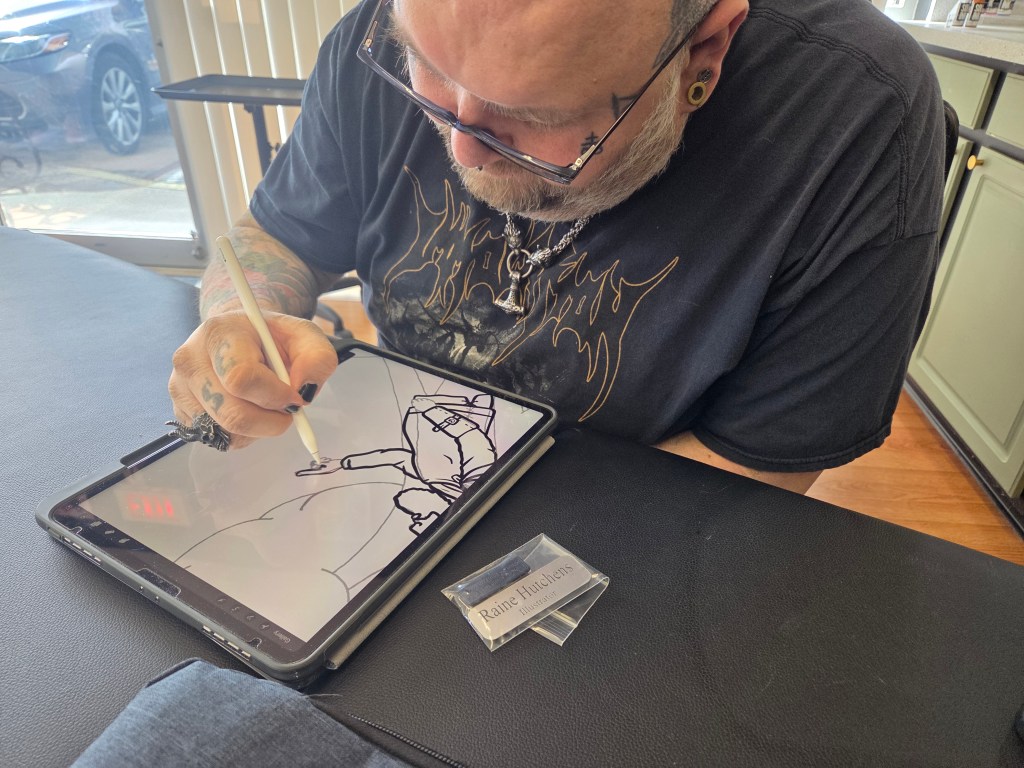
Heading questions are as asked and author’s notes are in orange or in [brackets]. Responses are often paraphrased—Raine talks very fast when he’s talking about something he cares about, and Martineau struggled to keep up!
What do you remember as the moment you wanted to be an artist? How long have you been an artist?
I’ve been an artist all my life. Since I was little, it was like a tradition. I don’t know if it’s just something people do in Appalachia [where Raine’s from], but for me, it started with homemade Christmas decorations. Every year for Halloween and Christmas, I would draw and craft construction paper and make decorations for the house. That was all the decorations, just whatever I made we had inside. That was when I realized I liked making things and realized art was a form of creation that gave me something I could control. Art was an outlet, and I was able to create my own reality in my art. In high school, I remember my teacher, Mr. Gross, had a lasting impact on me. He helped me express myself through art. That’s when I knew it would stick with me.
Who or what drew you to art?
In the beginning, it was me and my desire to create, but Mr. Gross really pushed me out of my comfort zone and pushed me to be expressive with art. The desire to express myself was a big part of it. Art is fun and cathartic but being able to express myself was a new addition to that positive feeling, and that drew me more and more.
What’s your favorite medium and why?
I really like collages. As far as medium, pen and ink/ink and marker on mixed-media paper is my favorite. It’s tangible. It lets me produce something I can show. I’m really into comics and graphic art, and that draws me to ink too.
What’s your favorite subject or style and why?
Woodblock print. Huge fan of that. Mostly just all the linework. It’s an old art style I just really fell in love with. [We are both super into that.]
What made you decide to become a tattoo artist?
Tattooing combines my loves of art, creation, and caring. There’s a whole group of people who need therapy and are too afraid to get it. Being a tattoo artist allows me to get closer to people and be a soundboard or helping voice while providing them with a safe space. Plus, I like to draw on people!
What’s your process when creating a design?
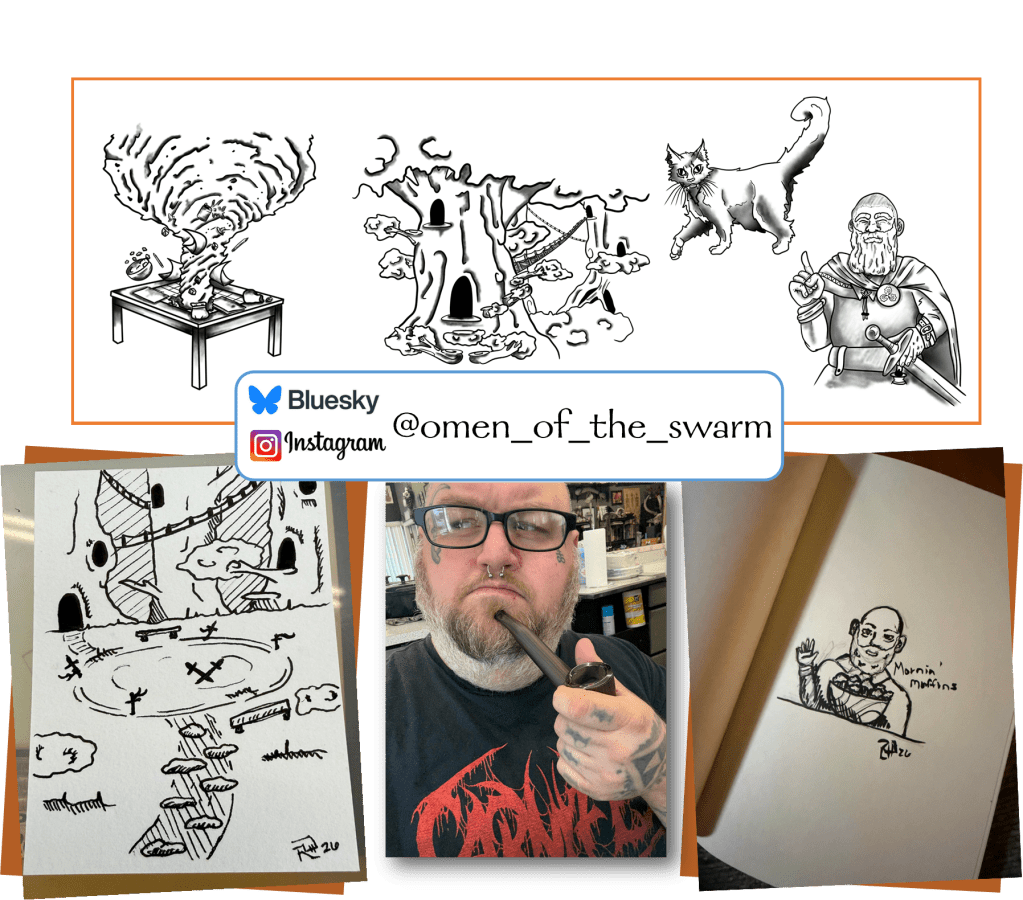
It starts with an idea and then it’s a lot of … man, it’s hard. It’s like I’m being asked to show my work. [Ha!] It starts with the idea, and then I collage references together into some version of my idea. I use those references and build on top of them. For the Tales of Ambergrove illustrations, I sent a concept and got the author’s feedback, and then I took her feedback and finalized the design.
What’s your background with fantasy or TTRPGs (tabletop role-playing games)?
I’ve always been interested in fantasy. From a young age, I remember my mom playing Final Fantasy games, which got me into magic and sword and sorcery. I was interested in Conan the Barbarian and stuff like that. When I was in middle or high school, I had a group of friends who introduced me to Dungeons & Dragons (3.5E). I remember, when we were playing, my friend John asked, “Do you want to see the ever-giving bugbear?” He played a bugbear and I played a paladin, and we just fought first—just did the encounter—and then he said, “Okay, roll the treasure table.” We rolled and rolled just a whole bunch of treasure; we looked through loads of things and talked about how the bugbear would have gotten the treasure or carried it and how my paladin would carry it, and that really got me into the mechanics.
After that, it became a monthly thing with friends from high school. We had a resident DM [Dungeon Master], and I really got into it. It was like how art was a different reality; I got to live in a different reality with D&D—one where I was a hero. I slew monsters and kept people safe and climbed through dungeons. I couldn’t do any of these things in real life. Being able to have those experiences and be a hero was incredible.
From there, I started running games, and that allowed me to create the story myself and allow people to experience my own ideas. I moved to Bloomington and got involved in the gaming industry. I was offered a job as a gaming journalist, and my employer took me to GenCon [an annual gaming convention in Indianapolis, Indiana]. After that, I was absolutely hooked. I sat down with the CEO of Paizo [Pathfinder,now also Starfinder] many times—more than I can count on one hand—and with reps from Wizards of the Coast [Dungeons & Dragons]—and I attended writing seminars at GenCon led by Paizo writers.
I continued to be forever DM for a while [always being the DM and rarely a player], learning about different RPGs and what OSR is and Mörk Borg. [OSR is “Old School Renaissance”—getting back to the basics and the feel of the original tabletop games. Mörk Borg is a unique, apocalyptic fantasy tabletop RPG.] Through my time at GenCon, got to cosplay for companies and demo games, and I enjoyed working with the public. It pushed me to make my own adventures and publish them. [These were previously on Patreon but are currently inactive.]
For those, I had to do everything. Learn how encounters work, create art for my creatures and weapons, and put it all together into a resource. It came full circle because I was able to see the gaming world from all facets—from creation to publication. I got all of that. That led me where I am now, doing the things I love. I’m also working on my own TTRPG that’s inspired by RPGs like Mörk Borg. Fantasy and TTRPGs are really in a lot for me.
What brought you on board as the Tales of Ambergrove illustrator?
Putting my art out there and really taking that risk to make the things for myself is what got me noticed. It was my work and my art that spoke for me. The writer asked if I was interested and I jumped at it, and now I’m stuck [in a good way]!
What is one thing you want Ambergrove’s readers to know about you?
This is a project I’m passionate about. This isn’t just a thing I’m doing. I’m invested in the characters and the story and the story’s creator.
What advice would you give to other artists?
The same advice given to me: Do not let the fear stop you. Whether you’re afraid it’s not good enough or no one’s going to like it, just know: If you like it, it’s good enough. Do it for you. Put it out there. Keep doing it. The more you do it, the easier it is to do.
Final thoughts?
Experiencing D&D, it’s not some sort of satanic thing like so many people have attributed it over the years. It’s not. It’s being a hero. We all want to be heroes, and Ambergorve is a testament to that. It’s important to be able to be heroes, especially, I think, to young girls who need to learn they’re not objects. They’re not; they’re heroes.
Thoughts from the Author
It was great for me to get to sit with Raine for a couple hours and talk about art, fantasy, tabletop role-playing games, and a bit just about Ambergrove. It’s things like this that make me so sure I made the right decision in asking Raine if he would come on as my illustrator. I found myself saying, either with my words or just my face, “That’s awesome!” through much of our talk.
In my dedication to the reader in Ranger’s Odyssey, I say, “For years, my husband has tried to teach me not to lose sight of the things I love because I don’t have time for them or I think I’m not good enough. If you make the time for the things you love, who you are and what you do will always be good enough.” It was great to have Raine share that sentiment from his own experiences as well. I love Ambergrove. It is so dear to me. The characters are imperfect, but they are real, and if you learn one thing from those characters, it’s that everyone can be a hero. That means you too.
I’ll close this with a reminder that our Kickstarter for the new editions of the Tales of Ambergrove books with Raine’s illustrations will be launching April 1. You can save the Kickstarter here to be reminded when it’s open for backers. We hope to adventure with you in April!

 Tales of Ambergrove