Authorly Advice 4: Blurbs, Keynotes, and Keywords

This March advice comes in part from a workshop I held back in 2023. Today, I’ll be talking about writing the author blurb and the back cover blurb, creating a keynote, and selecting keywords.

Author Blurb

Provide targeted information about yourself. The About the Author gives you the chance to introduce yourself to your readers and typically includes these main elements: education, current career, other publications, family information, and regional interest (e.g., city and state of residence).
Include relevant information. Have you been published before? Have a degree related to your subject matter or to writing? Think about what makes YOU the qualified person to write this story.
Include interesting information. Readers like knowing some personal info about authors. Things like hobbies, pets, and family. Many authors also include education and general location.
Keep it simple. In most cases, the book is what sells, not the author. Be sure to keep it short and sweet and include more information about your book than you do about yourself. The author blurb for the cover or back flap is typically about 50 words in length.
Write in third person. Don’t use “I” in your author information. Write like you are talking about someone other than yourself.
What about an author biography? If you have many accolades or additional information about yourself you would like to include, do it! Just not on the cover. Keep the cover text short, and include a full author biography in the back matter. These are usually a full page or two. I have an extended author biography on my website that just has more information about my interests and how those contributed to my books.
What about a photo? When selecting an author photo, you have two basic options. First, you could go to a professional photographer and have a professional author photo taken. An experienced photographer should be able to assist you in creating a photo that serves you well. I go to Icarus Photography in Bloomington for my cover art photography, and I highly recommend her for any photography needs. Second, you could include a photo that fits the subject matter of your book. My author photo is a nonstandard photo. I don’t want to have my face in it for various reasons, but I compiled/made a costume that aligns with my book.
What if I don’t want to include _? Great! You don’t have to. Readers are not owed information about you. You can come up with a fictitious blurb for a pen name or keep it vague or even blank. I am careful about what information I include. Only include what you want to.

Book Blurb: Fiction

Include details such as plot, setting, main characters, and some of the conflicts those characters face. You should reveal enough about the general outline of your story to draw readers in without giving away any crucial surprises that may appear in your plot.
Who are the main characters? What are they like? Think main characters, not a bunch of background people. You don’t want to have too many names in marketing copy, so think 2–3. Character names and basic descriptions are imperative to writing interesting blurbs. Don’t try so hard to be vague that we don’t even know who the main character is.
Where is the story set and what time period? Also, is the setting relevant to the story? If so, tell the reader why.
What is the main conflict? Conflict is what makes a book interesting and drives the story. Consider what the main characters wants/needs and what or who is keeping the character from that goal. Include the main conflict in your blurb.
Do not be vague or obscure. This is not an abstract concept of your book or a personal opinion of its quality. Your blurb needs to be a detailed account of who/what/where/when. Be sure to include at least two significant plot points that do not give away your ending.
More is better. You’ve heard the adage “less is more.” That is not true in the blurb for your readers. Make sure you include enough information about your story to set it apart from others of the same genre—don’t try so hard not to give things away that you give away nothing that wouldn’t also describe a thousand other romances, adventures, thrillers, or what have you. As long as you don’t give away the ending—or a twisty-twist!—you’re probably not giving too much.
Tensing should progress to draw interest. The blurb should progress from present to future tense as we build toward the omitted end. It’s “here’s what the characters are doing, but will they be able to do _ or will the story end in tragedy? Read more to find out what happens next!” Even if the entire book is written in past tense—as is standard for fiction—the cover text is always progressive from present to future to garner interest in what’s next.
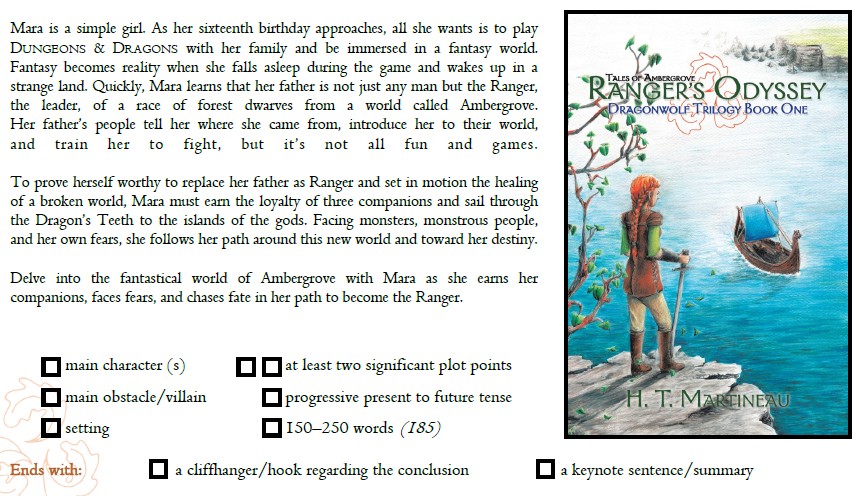
Blurbs are typically divided into two to three paragraphs and a keynote. Your first paragraph introduces your main character and the necessary background, time, and setting information. Your second paragraph introduces the conflict and at least one of the big plot points. Your third paragraph wraps up the information and raises a question as to later elements of the story. A final sentence (keynote) summarizes the main storyline in one punchy end. This is sometimes combined into the third paragraph and a separate keynote is created for marketing materials instead of combining them into one. An endorsement (if included) would be before or after the full blurb.
Your book blurb should always be longer than your author blurb. The typical book blurb is about 150–250 words in length. In contrast, your author blurb should be about 50 words. Even if your name can sell your book on its own, it shouldn’t. Include a small serving about yourself and a healthy helping about the book.

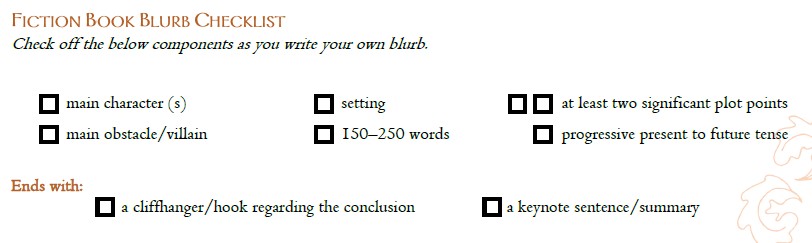
Fiction Book Blurb Checklist:

Fiction Example

Book Blurb: Nonfiction

Include details such as general information about the major points or purpose of the book. Your text should state what your book is about, how it’s unique, and what a potential reader might gain from the book.
What is the point of your book? What do you want the reader to gain from it? Is your book meant to be a resource? If so, how? What tools does your book have that would benefit the reader? What view does your account provide? Simply, why should a reader buy it?
Do not be vague or obscure. Provide details about main points discussed in your book, either in the form of a bulleted list or a few examples structured in a paragraph.
Why did you write it? How is it unique? Nonfiction works typically have a drive behind them. Are you writing a memoir to share your story to help others? A biography to share the legacy of someone great? A cookbook because you love your grandmother’s recipes and know others will too? A new teaching tool for others in your field or a revolutionary guide for clients? What sets it apart from other books on the same topic?
More is better. You’ve heard the adage “less is more.” That is not true in the blurb for your readers. Make sure you include enough information about your book to set it apart from others of the same genre—don’t try so hard not to give things away that you give away nothing that wouldn’t also describe a thousand other cookbooks, biographies, health books, or what have you. Give as much about important broad topics as you can fit into the recommended length.
Tensing should progress to draw interest. In fiction, the blurb should progress from present to future tense as we build toward the omitted end. In nonfiction, the blurb is typically factual and thus in present text (“the book has this and this and this”). However, there is also an element of future tense if the reader is meant to learn or do something. “Unlock your own future in The Future of the Past” or “In this book, learn how to face your fears and cook something even your mother-in-law will love!”
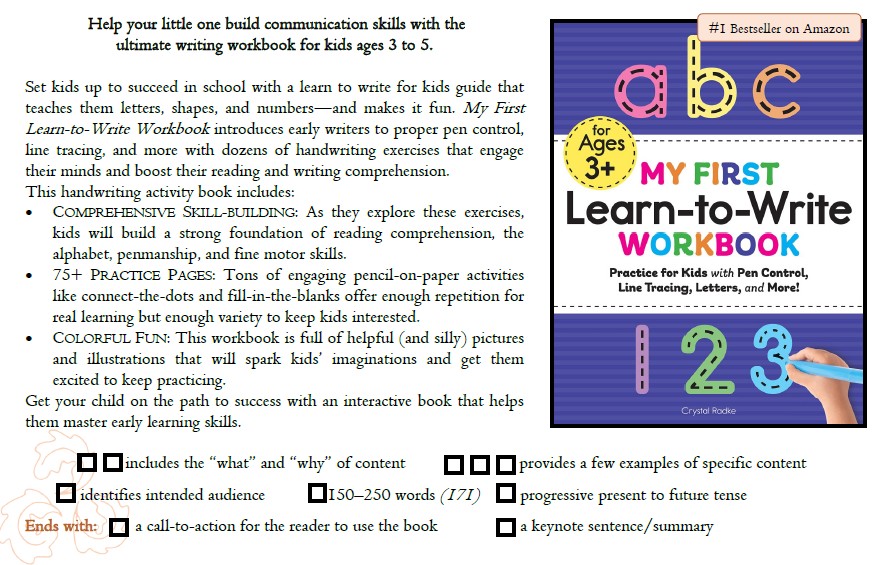
Blurbs are typically divided into two to three sections and a keynote. Your first section/paragraph introduces your book and the “what” and “why” of it. Your second paragraph lists or summarizes some important details. Your third section leads into your call-to-action. A final sentence (keynote) summarizes the general matter of your book while also calling the reader to use what’s within. This is sometimes in the third section and a separate keynote is created for marketing materials instead of combining them into one. An endorsement (if included) would be before or after the full blurb.
Your book blurb should always be longer than your author blurb. The typical book blurb is about 150–250 words in length. In contrast, your author blurb should be about 50 words. Nonfiction books should have information about you to show why you are qualified to share what you know, but the contents should sell the book in addition to your name.

Nonfiction Book Blurb Checklist:

Nonfiction Example

(pulled from the internet; no affiliation to Tales of Ambergrove)

The Book Blurb: A Trailer for Your Book

Think of your book like a movie. To get viewers to go see a movie, production companies release trailers to tell the potential viewer a little about the movie and to grab their interest. The turn of the century trailers (the ones that still had narration) were the best examples of this as they relate to cover text, and my favorite is Hidalgo (2004).

Loose Transcription of Trailer

Italics—written; (parenthesis)—spoken by a character; [brackets]—description of scene; bold—narration.

  • Based on a true story, they were an unbeatable team, the best of the best, until they faded from legend.
  • (Buffalo Bill: Frank Hopkins and his horse, Hidalgo, are legends. They’ve never lost a long-distance race.)
  • For Frank Hopkins and Hidalgo, their days of glory were over. [In an arena, Frank falls from Hidalgo’s back, and Hidalgo drags him.] Now, they’re about to get one last chance.
  • (Aziz and a bald man tell him about the race: Perhaps you have never heard of the Ocean of Fire, a 3000-mile race across the Arabian desert. The winner’s purse makes the victor very rich.)
  • (Frank to Hidalgo: You think we got one more in us? Yeah, me neither.)
  • [Told again of the race by the British man in the desert.] (Brit: Do you know what you’re up against, my American friends? The Ocean of Fire is not just a race. It’s full of obstacles that you can’t even imagine.) [quicksand, sandstorm, and locusts] (Frank, eating a locust: Once you get past the legs it ain’t too bad.) (Brit: And if the elements don’t kill you, your fellow riders will.) [swordfighting and gunfights with other riders]
  • It began as a race for riches (Sheikh to Frank: Bring my daughter back to me.), but it would become an adventure beyond anything he could ever imagine. [various scenes trying to save the Jazeera]
  • This Spring, experience the incredible true story of a man who left behind the world he knew (Sheikh to Frank: You are gambling with your very life.) and found the courage to do the impossible. (Jazeera: Why are you risking your life for me? Frank: Well, my horse likes you. Jazeera: Hidalgo’s the one who believes in you, but can you believe in yourself?) [riding with determination]

Possible Book Blurb (205 words)

Frank Hopkins and his horse, Hidalgo, had never lost a long-distance race—but their days of glory were far behind them. Hopkins and Hidalgo became performers, and Hopkins found rock bottom in the middle of a show. But when Hopkins is told of a three-thousand-mile race called the Ocean of Fire, he and Hidalgo have one last chance to prove that they are truly the legendary racers they were once thought to be.

The Ocean of Fire is not just any race. Once Hopkins and Hidalgo set across the Arabian desert, they must withstand more than they’d bargained for. The elements are challenge enough, but when the weapons come out and the sheikh’s daughter is kidnapped, Hopkins quickly learns that the stakes of this race will drive men to do anything to become the victor. It began as a race for riches, but it becomes a race for survival. Hidalgo believes in his rider, but can Frank Hopkins believe in himself, save Jazeera, and still win the race when he must fight a new enemy at every turn?

In Hidalgo, experience the incredible true story of a man and his horse, retired racers who find the courage to risk it all for one final race.

Keynote

The keynote often comes with the book blurb. The last sentence of the book blurb is typically a summary of the text as a whole. One punchy sentence about the book. Below is an example from my first book:

  • Ranger’s Odyssey: Delve into the fantastical world of Ambergrove with Mara as she earns her companions, faces fears, and chases fate in her path to become the Ranger.

Keywords

For younger writers, think hashtags. What are a few commonly searchable words a reader might use that would apply to your book? The standard number for most listings is seven keywords. Not sure why. Seven is a lucky number, so let’s go with that.

  • Ranger’s Odyssey—fantasy; quest; fate; teen; monsters; odyssey; adventure
  • Realm of Chaos—fantasy; quest; fate; teen; chaos; adventure; Ambergrove
  • Wheel of Fate—fantasy; fate; teen; chaos; family; adventure; Ambergrove

In a series, keywords may be exactly the same or change slightly, depending on the topic. Unless you are already popular online, don’t use your name in your keywords. I added “Ambergrove” as a keyword for later books in the series because that’s the world name, and it will be a commonality if someone reads the first book and searches for more, but as a rule, keywords should be broad terms that are likely to be searched by someone who hasn’t read you before.

Authorly Advice 3: Editing for Non-Editors

The February advice blog comes from a workshop I ran in 2023. Aside from the actual writing, editing is the most important part of completing a book. You can market an edited book, but you can’t edit a marketed book. If you have to choose between paying for editing and marketing, choose editing. This doesn’t mean you send your first draft to an editor; there are many editorial tasks you can do on your own that will benefit your book.

Why is editing your book on your own so important?

While all or most of you will send your manuscript to a professional editor before publication, any changes you can make yourself will help you appear more professional to other publishing industry professionals and will help your work get noticed.

Someone who knows the source material and doesn’t have to guess intent is more likely to revise in a way that benefits the book. If you review and make small changes for clarity throughout, you are more likely to get your point across so your intent is retained with the editor and understood by the reader.

There are many things a typical editor won’t or can’t do to your book. Often, the editor’s review is intended to be a simple grammatical review. If you review on your own to correct certain elements and improve your drafts, the final product you sent to your editor will be better before editing—and thus better after.

Editing can be pricey. The more you can do yourself, the less you would need to pay an editor to do. If you can make global fixes that do not require an editorial eye, you may greatly lower the cost of retaining a professional editor.

Checklists Are Your Friend

You know your writing style, and you know your needs. Checklists help you stay on track and ensure you don’t skip over something important.

In my books, I create a running list of things I know I’ll need to got back and do after the first draft, and anywhere I can I create notes for myself to make sure those things aren’t missed. So, my checklist would include “go back and check for continuity of travel times” and in the manuscript I would have a bracketed note—[check travel time here]. Brackets can easily be searched in Word and corrected en masse.

Images

If you are including charts, illustrations, or other inserted images, you need to make sure that they are prepared for publication. Images for print must be 300dpi or higher. If you include a lower quality image, it will appear blurry. Because images bog down your manuscript file, until you are sure how your publisher wants you to submit them, include all your images in a separate folder and rename each image accordingly. To check the dpi, right click the image in its folder and select “Properties.” In your manuscript, you will include bracketed notes for the interior designer/publisher. It is helpful to include a description for reference until the image is inserted. In my experience, red text is preferred for design notes. I also include highlighting for good measure.

 Nonfiction: References

For nonfiction, the most important element to sort out is often the referencing.

Any time you reference outside material to support or rebut a claim you present in your book, you need to make sure you have a proper citation for each. For each bit of outside information, you just have to provide enough information for the reader to find it in the same source, so they know what you know. Whether or not your source is credible or your source’s source is credible is neither here nor there. All you need is the necessary information for your readers to find the same information where you found it initially. So if a reader says, “Hang on, that bit about ____ seems a little far-fetched” or “Man, I would love to know more about ____,” the reader has the information to go to your source to see why you said what you did.

Make sure you copy the text exactly as it appears in the version you used. If anything is altered at all, you need to identify it. Replace omitted text with ellipses and include altered text in brackets. (i.e. Martineau says, “Any time you reference outside material … [I] need to make sure [I] have a proper citation for each.”)

Research

There are many different citation formats, including MLA (what most of us learned in school, APA (typically for psychology-related materials, and Chicago. Chicago is the publication standard. Full citation information may be found here (https://www.chicagomanualofstyle.org/tools_citationguide/) However, all you need to have to avoid having to pay a fact-checker to research materials you already looked at is basic information about each source.

  • Author name
  • Book title
  • Chapter or article title
  • Publisher
  • Website link for online sources
  • Publication/access date—date the book you read was published, or, if it’s a      website, the date you accessed it (so readers know which version you viewed).
  • Page numbers referenced—on your reference page, you would include all pages referenced at any point. Your in-text citations would be specific to each example.

Fiction: Dialogue and Tensing

For fiction, the most important elements to sort out are dialogue and tensing.

Dialogue structure covers outer (external) dialogue, inner (internal) dialogue, dialogue tags, and spacing.

Outer Dialogue

The most common dialogue, outer dialogue is anything that is spoken out loud. Each time a speaker changes, the new   dialogue should appear on a new line. Everything spoken by the same person should appear as one paragraph unless     multiple paragraphs of unbroken dialogue by one person are included, In that case, An open quote would be used for every paragraph with no close quote until the speaker is finished and you move to the next thing. Only the things that are said should be in quotes. Dialogue tags, narration, and action are not in quotes.

Inner Dialogue

Less common than outer dialogue, inner dialogue is anything that a character is directly thinking—anything that would be in quotes if it were spoken. Inner dialogue is set in italics, but it is otherwise structured just like outer dialogue.

Tags

Dialogue tags are connected to the dialogue, indicating how something was said or thought and who was doing it. They can only pertain to how words were said. You can laugh while talking, but you can’t laugh the words. You can whistle  between words, but not as a way of saying the words.

Use one tag per section of speech. The tag should only be paired with one quotation unless it interjects a full sentence.

When a tag appears before the dialogue, a comma should be used to join the two. When a tag appears after dialogue, the punctuation depends on the last sentence of dialogue. A period is replaced by a comma. Exclamation (!) or question (?) marks are retained, but the tag is still lowercased with a period at the end.

Putting it all Together

I hate this, she thought. Why does it have to be so complicated?

“Are you OK?” he asked. “I know I’m not saying much here, but pretend this is a full paragraph. Of many lines.

“This is lengthy for the sake of example. If this were the second paragraph by the same person, the last one would have no end quote.

“This is the end of the second speaker.”

She whistled. “Wow, that is simpler than I thought,” she said.

“Things usually are simpler than we think,” he replied, tapping her on the shoulder, “but you’ll figure it out with practice.”

Tensing

There is no official tense for fiction, but past tense is the unofficial standard. While present tense does work for some   stories, it is usually simpler to align to past tense. Whichever you choose, take great care to ensure that you keep the same throughout. Flashbacks or flashforwards are often set in italics to distinguish them, and those may be in another tense as long as they are the same relative to each other.

Incorrect (mixed): She ran through the forest. “Just try to catch me!” she says.

Correct (past): She ran through the forest. “Just try to catch me!” she said.

Correct (present): She runs through the forest. “Just try to catch me! she says.

Conclusion

While this all may seem like a lot, these rules barely scratch the surface of editorial standards. There are many little revisions that authors can make to polish their books in preparation for editing, but there is no substitute for editorial expertise. Just be sure you review and revise your book to the best of your ability and research potential editors before you select one.

Authorly Advice 2: Authors as People

The January Authorly Advice blog comes a couple days late due to the topic of the month: authors as people. When we’re young and discover reading for the first time, authors seem like otherworldly beings—more legend than person. As we grow, we learn what fandom means, and we idolize our favorite authors. We may not realize then the responsibility authors have.

Humanity in Fallibility

Authors are people. This in itself is not a revolutionary statement. However, people tend to put too much pressure on themselves to become infallible. Infallibility, while admirable, is unrealistic simply because of the nature of living a life. Sometimes we literally fall down, and whether that is the case or we “drop the ball” in forgetting an appointment or another fashion, we will fall—at least a little bit—no matter what we do.

Two weeks ago, I fell—literally. I slipped on ice and fell, and I hit the back of my head on a tree root. In an instant, everything I’d said and planned for the year was also on shaky footing. I went to the ER, I had tests, I went to the doctor, the chiropractor, physical therapy, and more, and I learned that this head injury was substantial enough to throw off all my plans for at least a full month—which would cause cascading changes throughout the year.

I can no longer spend hours in front of the computer working on a manuscript draft. I can no longer work on editorial tasks. As of today, I can hardly walk without support. This came mere days after cementing my month-long plan and sharing my plans for the year. Sometimes, plans have to change.

Meeting a deadline is possible in some cases but not all. We are not programmed to spit out a certain number of words per day to ensure we reach our goals. Maybe we won’t reach those goals. Maybe we need more time. Maybe we need to stop and think. Maybe there’s an illness or disaster outside our control. Maybe we have other commitments and have to make the difficult decision between them.

The important thing in these cases is to be honest. Being honest does not mean baring all, but it does mean that what is laid bare must be honest. Fallibility is part of being a living being, but honesty and genuineness are choices.

Humanity in Responsibility

Authors have a responsibility to honesty. Whether that was the plan or not, the moment someone puts themselves out there for the public—musicians, journalists, actors, field experts, and so on—they become a public figure. Someone, somewhere, looks up to them and admires what they do. People have to know that the person they look up to is trustworthy. Do I know what my favorite author had for lunch today? No. Does she have to tell me if I ask? No. However, if I ask and she chooses to tell me, what she shares must be honest. “I had something tasty,” if true, is certainly enough information for her to share as a public figure. She may choose to photograph her lunch and ping the restaurant, but that is a choice. She is not being dishonest in saying it was tasty. We are not owed any personal information, but if the choice is made to share, the choice must also be made to do so honestly.

Authors also have a responsibility to character—to their characters in their books, yes, but also to their own moral character. While authors may have pen names and may embody personas instead of sharing their true names, the person they present as this public figure must not directly contradict their own character. This does not mean that someone who dresses one way as the public figure must do so as themselves. It means that the moral beliefs they hold themselves to must be the same. When a reader grows to love the writing, they may also become fans of the writer. They expect that person to share the moral codes presented in the writing or presented by the writer as a public figure. To not match what beliefs are presented breaks the trust with the reader. This does not mean readers must know the author’s religion, political stance, or other beliefs, but if they matter, if those things directly contradict the stories, it breaks trust with the reader if those details come to light later on.

I had a favorite author, whose name I won’t mention, who stated once that writing fantasy was easy because fans of fantasy would love whatever garbage was given to them, so it was a good way to make a buck. That was the reason he wrote his fantasy books, and it was the honest answer. This caused a rift between those lovers of fantasy—of that series in particular—and the author who held such disdain for even his own readers, and it broke that trust.

Having a responsibility to your own character doesn’t mean having good character, though perhaps that should be the goal. It just means your character, your values, should align with what readers of your books would expect out of you. Readers would expect a fantasy author to be a fan of fantasy himself. Readers expect a religious fiction author to be religious, a children’s fiction author to at least not hate children, and so on. If you present your stories and characters as allies to a marginalized group and then speak out against that group, you break trust with the reader. If your stories are clearly against a certain group and you speak out for that group or are yourself part of that group, you break trust with the reader.

Whether you like it or not, in becoming a public figure, in having readers who are fans of your work, you also have people who are fans of you, and that comes with responsibility—if you care (and you should). Your actions matter, because there may be readers who may base their opinion of themselves on what you say and do. If you don’t uphold the standards and expectations set by your characters, why should they? If they loved something so deeply that it became a part of them, and then you yanked the rug out from under them, they may question their own judgement.

If you are popular as an author, you are popular because of your readers. Your responsibility is to be genuine with them and ensure your character aligns with your characterS and the lessons you have them teach your readers. As noted in the previous blog, you write for yourself; you publish for your readers. As you continue to write (if you write more), you should continue to write for the reasons you started, but if you choose to publish, you should keep the readers in mind. Think of how your actions impact those around you, always, but as an author, think about how your actions impact your readers.

Finally, authors have a responsibility to themselves. If authors are people, authors have the same needs all other people have. We must eat. We must rest. The current Ambergrovian main character is a former smith, so let’s look at the “pouring from an empty cup” adage in smiths’ terms.

Your day is a blade in a forge. A blade can only be hammered so much. If the smith works the blade slowly and precisely, they can create something magnificent and strong. If the smith hammers too hard, the blade will become thin and brittle and will not stand to what coming days have in store for it. If you put too much pressure on yourself in the day (too much hammering in the forge), you damage yourself and you weaken what you can do in the future. If you work deliberately, rest deliberately, and stop when you’ve reached your limit, the work you do will be strong and you will be able to handle what the next day will bring. Tomorrow may bring a new blade to forge, but that doesn’t mean that today’s blade doesn’t need to be made well. That means the rest you take today matters just as much as the work for you to have a sustainable tomorrow.

This is an idea I’ve been struggling with my entire life. I have always equated my worth to how much work I could cram in the day, how many responsibilities I could take on, and I’ve viewed rest as something to be earned (and something I rarely ever earn). But rest isn’t something to be earned. Rest is necessary to help us become something strong. When a blade is forged, it spends time heating and cooling in addition to being hammered on the anvil. To be made strong, the blade needs all of it. What kind of blade will you forge yourself to be?

Conclusion

Being an author doesn’t mean being infallible, but your intention matters. You must ensure you remain a person that readers can look up to and ensure you do not break trust with those readers. However, you must also ensure that you look after yourself and do not hammer yourself too much. Maintain progress as you can, but sometimes life happens. When you fall and you need to rest, rest. Properly care for yourself. You are not only human after all—you are steel in a forgefire. Pace yourself and become a magnificent blade … and show your readers healthy ways to forge themselves as well.

Additional Note

It has been 15 days since I hit my head, and I’m improving somewhat—but not much. However, as I announced these blogs last month, I wanted to ensure I didn’t immediately drop the ball. I tried to do more. I did. I contested the advice to rest. All that happened was that I fell further. So, I stand by the advice here, but I do intend to reread and edit it once I’m back to 100 percent functionally.

New Developments, the Remainder of the Year, and Next Year’s Plans

As we near the end of 2024, we come to that annual time of reflection.

This Year

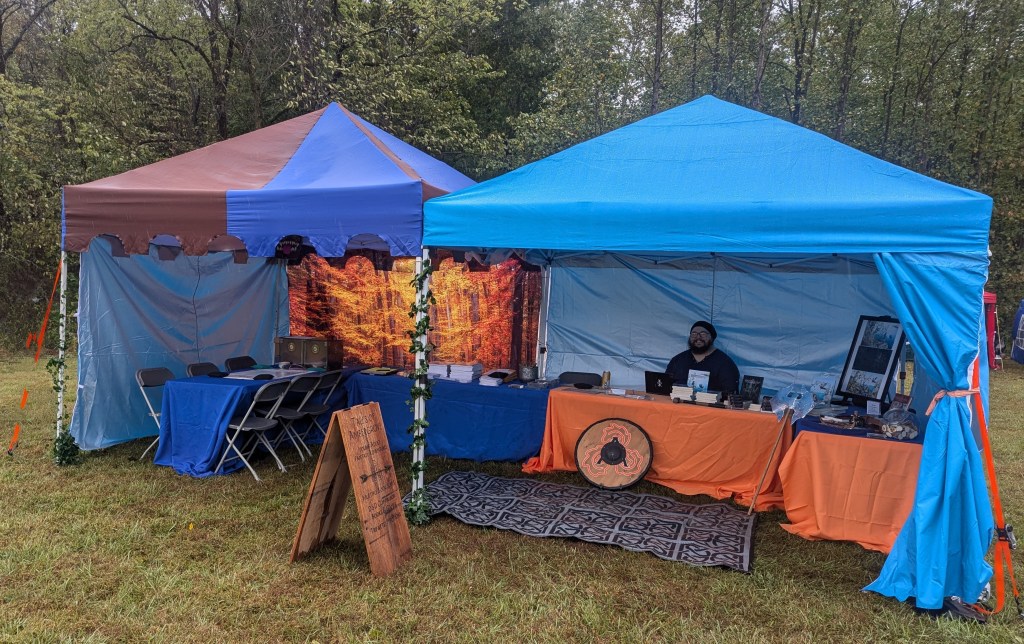
2024 brought quite a lot of developments—some positive and some not-so-positive. We participated in a couple new events this year: Lawrenceburg Public Library’s author fair and Clayshire Castle’s Medieval Faire. Both were fantastic events. Clayshire was unparalleled, even (or perhaps especially) taking into account that the residual storm from the hurricane came through and affected setup and attendance. Clayshire may be my favorite US event thus far.

I was out of a job for most of the year and was hustling to make ends meet while I tried to find a new one, so Ambergrove was put on the back burner for a while. Despite that, I was able to finish the D&D core book this year and send it to the publisher. It should be available within a few months. I also wrote a few short stories outside of Ambergrove this year, and one of them will be published in an anthology next year. Finally, I will be finishing up the Ember on the Anvil draft in a few months and hope to have that with the publisher by summer next year, as long as I can secure a funding avenue between now and then.

This year, I also started a monthly email newsletter and created a Discord channel! In addition, I created the Ambergrovian written language, Grovish, and created a downloadable font available free to anyone.

On a more personal front, this year brought Bandit to the family. She’s become my new helper and snuggle buddy the past month and a bit. She’s the spitting image of a cat I had and lost, one my family simply referred to as Boo Boo Kitty, though Bandit has her very own personality and temperament. She’s prone to big chomps and hiding when she’s not pulling a triple shift at the biscuit factory.

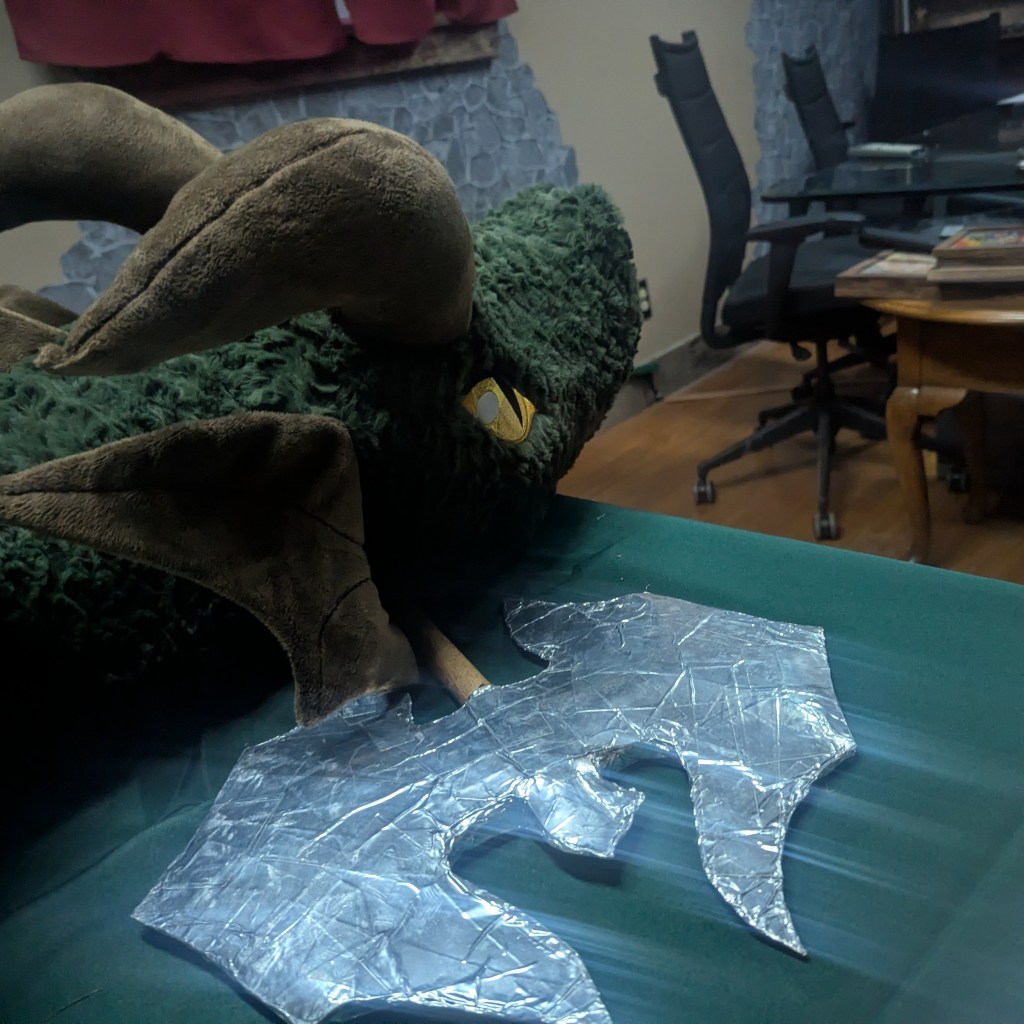
I also got Rowan as a present from my husband. She’s a giant stuffed dragon (technically a wyrm), and she makes sitting to work on EotA particularly comfortable and fantastical. She’s also the unofficial mascot of our D&D room.

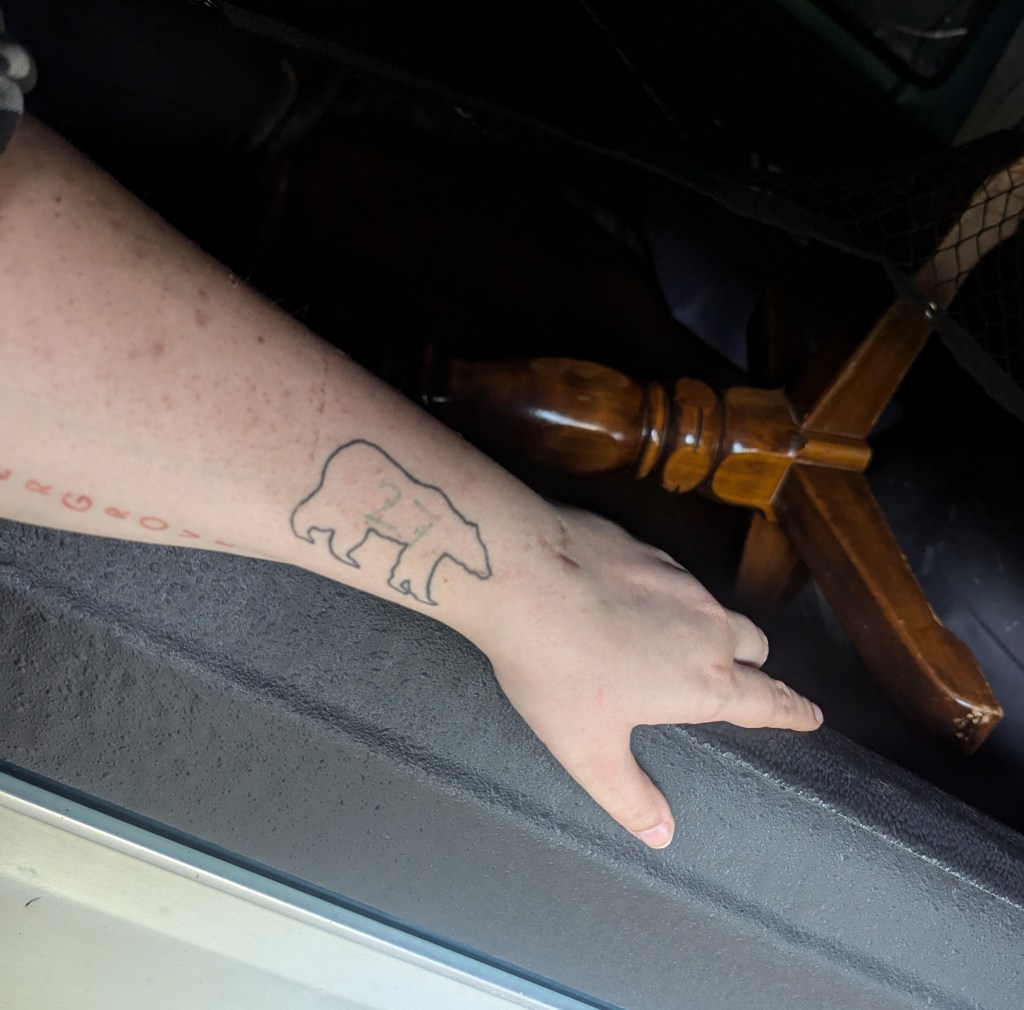
I was able to get my late uncle’s truck, one of two family objects I cared to have, after ten years trying to get it from the person it went to after my uncle passed. I have counted the times I’ve driven it on my arm, and by the end of the year, I should have driven it 37 times. I was able to take it to help out my old community theatre, I was able to take it when a storm came through and downed dozens of trees, leaving the county roads near-impassible and the power out for almost a week. I was able to drive it to Granny’s to pick up her table (the only other family object I cared to have), and I was able to drive it to work when I was finally employed again.

I also got an Oura ring this year under HSA, and I am baffled at how much it learns and how kind it is. It doesn’t shame you into pressing on; it tells you when you would be pouring from an empty cup and tells you to stop and rest. It has certainly helped to alter my mindset and help me to better prioritize self-care.

Next Year

I’ve updated the events page to reflect the currently planned events for 2025 and to hopefully be more intuitive. Returning events include Clayshire’s Medieval Faire and MCPL Author Fair. New events include Southern Indiana Renaissance Faire (2/5 weekends) and Indiana Enchanted Fairy Festival. I hope to add additional events in the coming months. If you’d like to see us at an event, reach out and we’ll see what we can do!

I’m working on Ember on the Anvil and then jumping right into Ember of the Flame once that is completed. The lofty goal would have Ember’s series completed in 2025, but we’ll see how things go. If I am able to publish both next year, we’re looking at summer and winter.

The Ambergrovian Adventurer’s Guide should be available near the start of the year. If all goes to plan with the novels, the first standalone book will be released in 2026 and the final printed D&D materials will be added. With Dawn of the Dragowolf and the Adventurer’s Guide, my published D&D companion set is complete. I will include some additional information on the website and will share canonical adventures, but the final Adventurer’s Guide will be the last published, and then the focus will return to the novels.

The anthology, Black Cat Tales, should be completed and available in 2025. The publisher still hopes to have an audiobook version available as well. I have one short story in this anthology, but there are many other talented writers featured in the anthology as well. Check it out here.

So. 4+ events next year and—hopefully—3–4 books published next year. 2025 will be a big year for Ambergrove!

A Bit of Authorly Advice

This year brought more difficulties when it comes to events because of storms. When our power was out and we were stuck at our house, I had to reschedule and event I had planned for a library’s summer reading program because I couldn’t get there. The weekend of Clayshire was when the Hurricane Helene came through. The wind hit Friday, but the deluge came Saturday. Despite the heavy rains hundreds of people came out, though more would have come were it not for the rains. The following weekend was the MCPL Author Fair, which suddenly found itself competing with a dozen outdoor events that had previously been scheduled for the week before. I had to back out of a new event I had planned to attend and ORF, a staple event, due to financial constraints.

What these all have in common is disappointment. Some attendees were disappointed at the events that were missed this year, but they were kind about it. They took humanity into account. The events with lowered attendance had less kind disappointment, and that’s what I want to talk about.

I’ve mentioned a few things about this on my socials this year, but here’s some more definitive statements.

  • Organizers put a lot into events and so do attendees. You should never be publicly disappointed about attendance or sales.
  • There are many factors that determine the success of an event. One of those things is weather. Sometimes things just happen that no one has any control over. Sure, if you can’t afford to set up at an event if you aren’t guaranteed a certain number of sales, that’s valid, but just because you didn’t get sales does not mean that event is unsuccessful. Sometimes catastrophic weather changes plans. Sometimes other events compete with that one more than expected. Sometimes your booth location means that more people plan to come back so they don’t spend all their money right away—or they’ve already spent their money by the time they get to you. None of these things mean an event is bad. If you decide it is not worth it to you to return to an event, that’s valid, and your reasoning is valid, but do not make your disappointment known at the event, and do not blame the event organizers for things out of their control.
  • Events are what you make them. Be positive. Be friendly. Be kind to the organizers. Help other authors or vendors. Talk pleasantly with attendees about the books first and worry about a sale second. My books are available free in libraries and are more affordable/accessible in digital formats. Sure, it’s better for someone to buy at events, but not just for the sake of doing it. Enjoy the event, take my card, and read the books for free from the library. Sales can sometimes determine success, but success cannot be determined by sales alone. Success is determined by the readers who love the world and its stories, and if you focus on them, you will always be successful.
  • Be kind to organizers. Stay involved and friendly at events, even if you’re disappointed in attendance or sales. Focus on the readers’ enjoyment as much as you can, and you will never be disappointed as an author.

Break the Arrow

As this year comes to a close and we prepare for 2025, I am elated. The years will always have their ups and downs, but that’s part of the adventure. We had some lows this year. We struggled as our personal stability became rocky and we had to back out of events, and when I had surgery last month and he had surgery last spring; through it all, my husband was always on my team. Through it all, I had pets (and more pets!), and friends, and D&D with family, I lost and then got a fantastic job, and I was able to do so much in Ambergrove.

Last year, while talking with my host parents and visiting a forest nun at a hermitage in Scotland, I was told the parable of the second arrow, and that has stuck with me. When we are shot with an arrow, this causes us pain. However, if we allow our thoughts to linger and be consumed by the fact that we were shot with an arrow, our own need to understand why, and our worries about whether we will be shot again, we are the ones who shoot ourselves with that second arrow. Sure, this is greatly simplified, and it seems to ignore the realities of things like PTSD, but the sentiment remains the same. When we dwell on the negatives of the past, we harm our future and our contentment with the present. This was the year I broke that second arrow, and I found that I am content with my experiences and happier with my choices. I choose not to dwell and shoot myself with that second arrow, yes, but I also chose to break that second arrow instead of shooting someone else with it.

I am happy with what life has given me and what I have worked for. I am proud of what I have done as an author and what I plan to do in the future. I am excited to continue to share Ambergrove with you.

Until next time, adventurers, be kind, be curious, and enjoy your adventures.