
This March advice comes in part from a workshop I held back in 2023. Today, I’ll be talking about writing the author blurb and the back cover blurb, creating a keynote, and selecting keywords.
Author Blurb
Provide targeted information about yourself. The About the Author gives you the chance to introduce yourself to your readers and typically includes these main elements: education, current career, other publications, family information, and regional interest (e.g., city and state of residence).
Include relevant information. Have you been published before? Have a degree related to your subject matter or to writing? Think about what makes YOU the qualified person to write this story.
Include interesting information. Readers like knowing some personal info about authors. Things like hobbies, pets, and family. Many authors also include education and general location.
Keep it simple. In most cases, the book is what sells, not the author. Be sure to keep it short and sweet and include more information about your book than you do about yourself. The author blurb for the cover or back flap is typically about 50 words in length.
Write in third person. Don’t use “I” in your author information. Write like you are talking about someone other than yourself.
What about an author biography? If you have many accolades or additional information about yourself you would like to include, do it! Just not on the cover. Keep the cover text short, and include a full author biography in the back matter. These are usually a full page or two. I have an extended author biography on my website that just has more information about my interests and how those contributed to my books.
What about a photo? When selecting an author photo, you have two basic options. First, you could go to a professional photographer and have a professional author photo taken. An experienced photographer should be able to assist you in creating a photo that serves you well. I go to Icarus Photography in Bloomington for my cover art photography, and I highly recommend her for any photography needs. Second, you could include a photo that fits the subject matter of your book. My author photo is a nonstandard photo. I don’t want to have my face in it for various reasons, but I compiled/made a costume that aligns with my book.
What if I don’t want to include _? Great! You don’t have to. Readers are not owed information about you. You can come up with a fictitious blurb for a pen name or keep it vague or even blank. I am careful about what information I include. Only include what you want to.
Book Blurb: Fiction
Include details such as plot, setting, main characters, and some of the conflicts those characters face. You should reveal enough about the general outline of your story to draw readers in without giving away any crucial surprises that may appear in your plot.
Who are the main characters? What are they like? Think main characters, not a bunch of background people. You don’t want to have too many names in marketing copy, so think 2–3. Character names and basic descriptions are imperative to writing interesting blurbs. Don’t try so hard to be vague that we don’t even know who the main character is.
Where is the story set and what time period? Also, is the setting relevant to the story? If so, tell the reader why.
What is the main conflict? Conflict is what makes a book interesting and drives the story. Consider what the main characters wants/needs and what or who is keeping the character from that goal. Include the main conflict in your blurb.
Do not be vague or obscure. This is not an abstract concept of your book or a personal opinion of its quality. Your blurb needs to be a detailed account of who/what/where/when. Be sure to include at least two significant plot points that do not give away your ending.
More is better. You’ve heard the adage “less is more.” That is not true in the blurb for your readers. Make sure you include enough information about your story to set it apart from others of the same genre—don’t try so hard not to give things away that you give away nothing that wouldn’t also describe a thousand other romances, adventures, thrillers, or what have you. As long as you don’t give away the ending—or a twisty-twist!—you’re probably not giving too much.
Tensing should progress to draw interest. The blurb should progress from present to future tense as we build toward the omitted end. It’s “here’s what the characters are doing, but will they be able to do _ or will the story end in tragedy? Read more to find out what happens next!” Even if the entire book is written in past tense—as is standard for fiction—the cover text is always progressive from present to future to garner interest in what’s next.
Blurbs are typically divided into two to three paragraphs and a keynote. Your first paragraph introduces your main character and the necessary background, time, and setting information. Your second paragraph introduces the conflict and at least one of the big plot points. Your third paragraph wraps up the information and raises a question as to later elements of the story. A final sentence (keynote) summarizes the main storyline in one punchy end. This is sometimes combined into the third paragraph and a separate keynote is created for marketing materials instead of combining them into one. An endorsement (if included) would be before or after the full blurb.
Your book blurb should always be longer than your author blurb. The typical book blurb is about 150–250 words in length. In contrast, your author blurb should be about 50 words. Even if your name can sell your book on its own, it shouldn’t. Include a small serving about yourself and a healthy helping about the book.
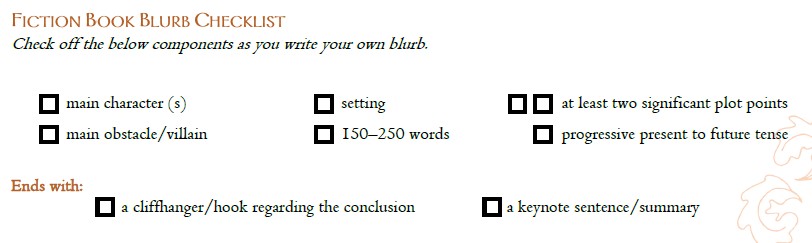
Fiction Book Blurb Checklist:
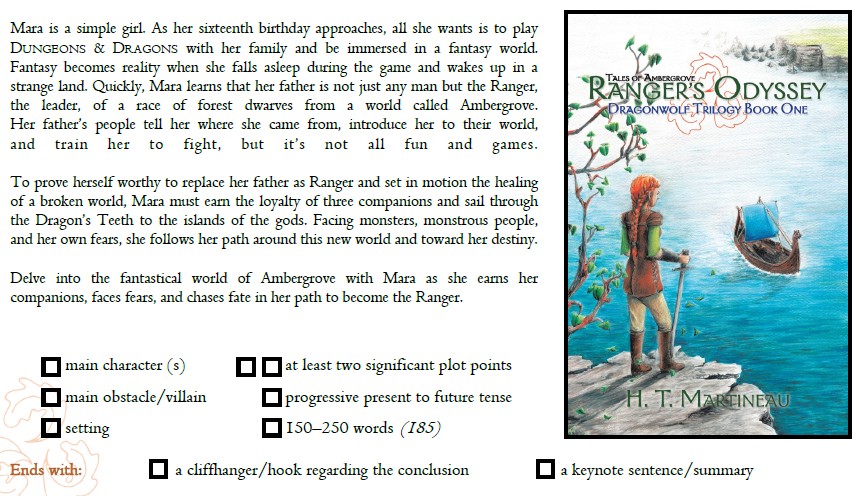
Fiction Example
Book Blurb: Nonfiction
Include details such as general information about the major points or purpose of the book. Your text should state what your book is about, how it’s unique, and what a potential reader might gain from the book.
What is the point of your book? What do you want the reader to gain from it? Is your book meant to be a resource? If so, how? What tools does your book have that would benefit the reader? What view does your account provide? Simply, why should a reader buy it?
Do not be vague or obscure. Provide details about main points discussed in your book, either in the form of a bulleted list or a few examples structured in a paragraph.
Why did you write it? How is it unique? Nonfiction works typically have a drive behind them. Are you writing a memoir to share your story to help others? A biography to share the legacy of someone great? A cookbook because you love your grandmother’s recipes and know others will too? A new teaching tool for others in your field or a revolutionary guide for clients? What sets it apart from other books on the same topic?
More is better. You’ve heard the adage “less is more.” That is not true in the blurb for your readers. Make sure you include enough information about your book to set it apart from others of the same genre—don’t try so hard not to give things away that you give away nothing that wouldn’t also describe a thousand other cookbooks, biographies, health books, or what have you. Give as much about important broad topics as you can fit into the recommended length.
Tensing should progress to draw interest. In fiction, the blurb should progress from present to future tense as we build toward the omitted end. In nonfiction, the blurb is typically factual and thus in present text (“the book has this and this and this”). However, there is also an element of future tense if the reader is meant to learn or do something. “Unlock your own future in The Future of the Past” or “In this book, learn how to face your fears and cook something even your mother-in-law will love!”
Blurbs are typically divided into two to three sections and a keynote. Your first section/paragraph introduces your book and the “what” and “why” of it. Your second paragraph lists or summarizes some important details. Your third section leads into your call-to-action. A final sentence (keynote) summarizes the general matter of your book while also calling the reader to use what’s within. This is sometimes in the third section and a separate keynote is created for marketing materials instead of combining them into one. An endorsement (if included) would be before or after the full blurb.
Your book blurb should always be longer than your author blurb. The typical book blurb is about 150–250 words in length. In contrast, your author blurb should be about 50 words. Nonfiction books should have information about you to show why you are qualified to share what you know, but the contents should sell the book in addition to your name.
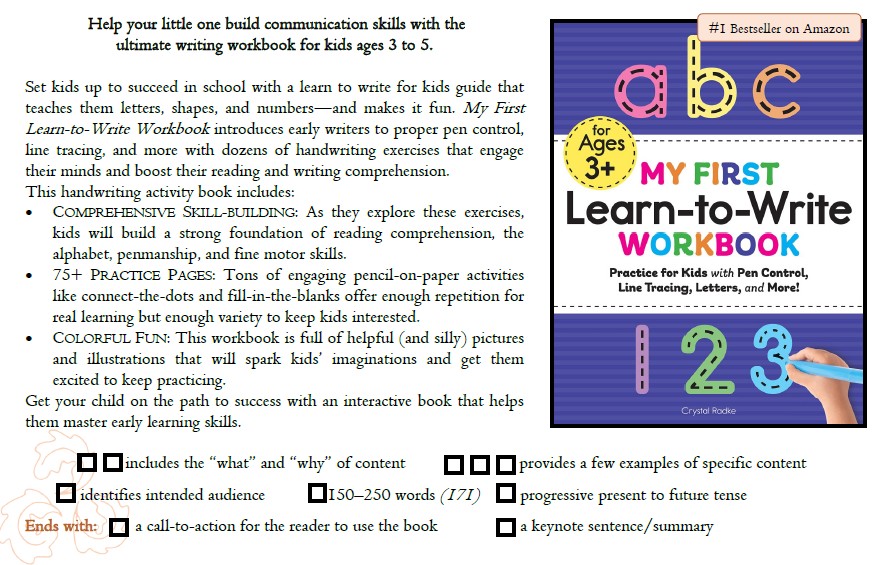
Nonfiction Book Blurb Checklist:

Nonfiction Example
The Book Blurb: A Trailer for Your Book
Think of your book like a movie. To get viewers to go see a movie, production companies release trailers to tell the potential viewer a little about the movie and to grab their interest. The turn of the century trailers (the ones that still had narration) were the best examples of this as they relate to cover text, and my favorite is Hidalgo (2004).
Loose Transcription of Trailer
Italics—written; (parenthesis)—spoken by a character; [brackets]—description of scene; bold—narration.
- Based on a true story, they were an unbeatable team, the best of the best, until they faded from legend.
- (Buffalo Bill: Frank Hopkins and his horse, Hidalgo, are legends. They’ve never lost a long-distance race.)
- For Frank Hopkins and Hidalgo, their days of glory were over. [In an arena, Frank falls from Hidalgo’s back, and Hidalgo drags him.] Now, they’re about to get one last chance.
- (Aziz and a bald man tell him about the race: Perhaps you have never heard of the Ocean of Fire, a 3000-mile race across the Arabian desert. The winner’s purse makes the victor very rich.)
- (Frank to Hidalgo: You think we got one more in us? Yeah, me neither.)
- [Told again of the race by the British man in the desert.] (Brit: Do you know what you’re up against, my American friends? The Ocean of Fire is not just a race. It’s full of obstacles that you can’t even imagine.) [quicksand, sandstorm, and locusts] (Frank, eating a locust: Once you get past the legs it ain’t too bad.) (Brit: And if the elements don’t kill you, your fellow riders will.) [swordfighting and gunfights with other riders]
- It began as a race for riches (Sheikh to Frank: Bring my daughter back to me.), but it would become an adventure beyond anything he could ever imagine. [various scenes trying to save the Jazeera]
- This Spring, experience the incredible true story of a man who left behind the world he knew (Sheikh to Frank: You are gambling with your very life.) and found the courage to do the impossible. (Jazeera: Why are you risking your life for me? Frank: Well, my horse likes you. Jazeera: Hidalgo’s the one who believes in you, but can you believe in yourself?) [riding with determination]
Possible Book Blurb (205 words)
Frank Hopkins and his horse, Hidalgo, had never lost a long-distance race—but their days of glory were far behind them. Hopkins and Hidalgo became performers, and Hopkins found rock bottom in the middle of a show. But when Hopkins is told of a three-thousand-mile race called the Ocean of Fire, he and Hidalgo have one last chance to prove that they are truly the legendary racers they were once thought to be.
The Ocean of Fire is not just any race. Once Hopkins and Hidalgo set across the Arabian desert, they must withstand more than they’d bargained for. The elements are challenge enough, but when the weapons come out and the sheikh’s daughter is kidnapped, Hopkins quickly learns that the stakes of this race will drive men to do anything to become the victor. It began as a race for riches, but it becomes a race for survival. Hidalgo believes in his rider, but can Frank Hopkins believe in himself, save Jazeera, and still win the race when he must fight a new enemy at every turn?
In Hidalgo, experience the incredible true story of a man and his horse, retired racers who find the courage to risk it all for one final race.
Keynote
The keynote often comes with the book blurb. The last sentence of the book blurb is typically a summary of the text as a whole. One punchy sentence about the book. Below is an example from my first book:
- Ranger’s Odyssey: Delve into the fantastical world of Ambergrove with Mara as she earns her companions, faces fears, and chases fate in her path to become the Ranger.
Keywords
For younger writers, think hashtags. What are a few commonly searchable words a reader might use that would apply to your book? The standard number for most listings is seven keywords. Not sure why. Seven is a lucky number, so let’s go with that.
- Ranger’s Odyssey—fantasy; quest; fate; teen; monsters; odyssey; adventure
- Realm of Chaos—fantasy; quest; fate; teen; chaos; adventure; Ambergrove
- Wheel of Fate—fantasy; fate; teen; chaos; family; adventure; Ambergrove
In a series, keywords may be exactly the same or change slightly, depending on the topic. Unless you are already popular online, don’t use your name in your keywords. I added “Ambergrove” as a keyword for later books in the series because that’s the world name, and it will be a commonality if someone reads the first book and searches for more, but as a rule, keywords should be broad terms that are likely to be searched by someone who hasn’t read you before.
 Tales of Ambergrove