
May’s authorly advice comes from my experiences but also, by extension, comes from one of my neurology specialists I’ve been seeing for my brain injury this year.
Anyone who has written has dealt with writer’s block in on form or another. We’ve spent hours or days just looking at a blank page or getting caught in the cycle of typing and deleting the same text a dozen times. We have our own strategies for pushing forward despite the overwhelming blankness, but what we don’t often have is someone telling us to stop.
Writer’s block, whatever its cause, is always seen as a hurdle to hop over, rather than a a bump in the turning wheel of writing. There are three stages of writer’s block/dealing with writing, and these are not progressive stages—they are part of a circle.
If driven by an extrinsic deadline, it certainly makes sense to push through. However, when we push to just write something, we often end up writing things that are below our usual standard. My advice in this instances has always been to leave notes and carry on. That’s the first step here.
Keep Calm and Carry On
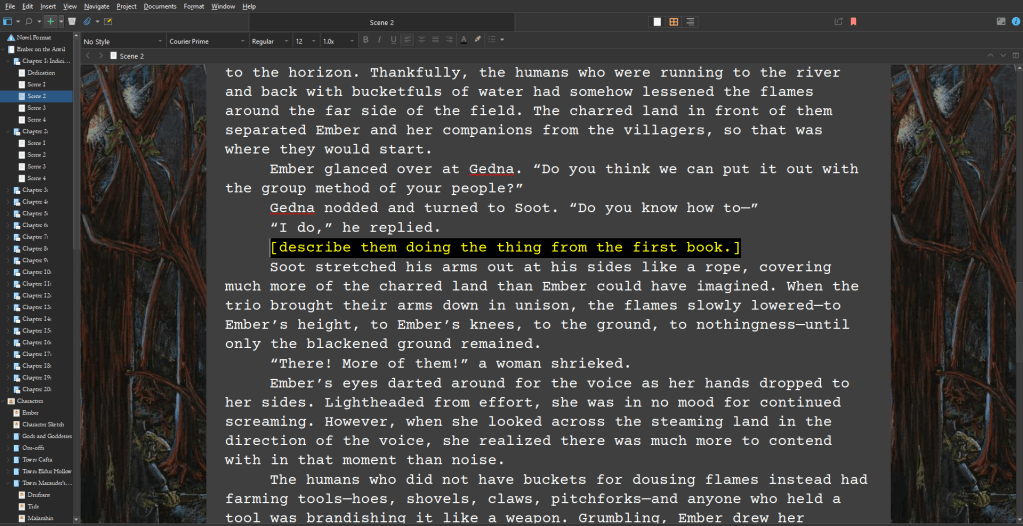
[write here about bracketed notes—yes, I left this on purpose]
In instances when you don’t know the next thing you want to write but do know the thing after that, bracketed notes are the best bandaid for writer’s block. If, for whatever reason, you have to just push on, bracketed notes will carry you forward.
I always push this, but that’s because it helps so much. Sometimes you just have to make it work and keep going, but that doesn’t mean you will magically know what to write. If you just write garbage so there’s something written, sure, you’ll have something to edit, but you’ll also put in more work that will later need to be undone. If you put a note in, [here I’ll talk about monkeys or something], you have an idea what that scene will be, but you don’t have to slow your momentum to think of it or look it up in prior works (as below) nor stare at a blank page. You can always go back later to add whatever you skipped, but if you allow that thing to prevent you from moving forward, it can hold you back indefinitely. Sometimes leaving a note for yourself so you know to come back and just moving forward can help you to come up with later details that can fill in the earlier gaps. Sometimes, but not always.
For many of us, if we don’t just stop and get stuck, this phase of pushing on is still where we stay, stubbornly refusing to step back—because we feel we can’t or because we feel we shouldn’t—and we forget or don’t realize there are two other valuable options.
Just Stop, Take a Break, and Regroup
Sometimes, the best thing you can do is just stop. When your brain cannot come up with the next thing to write, you may be experiencing burnout. Burnout is the body telling us to stop. I’ve talked a bit about this in another blog. Whether you pride yourself as a “mind over matter” person or you just cannot afford to take the break your body needs, burnout is your body begging you for a break.
In my case, right now, my brain is having difficulty coming up with the things I want to write because it is physically injured. I have spent nearly five months focusing on recovery and on giving my brain that break. I had deadlines and goals, but it does no good to push for the deadline if your writer’s block means that you’re presenting a garbled mess or you push yourself too far altogether. You can do too much.
At the end of the day, you are a human being who needs breaks. Take one. Go to a place you love, spend time with family or pets, get back to nature, watch a show or play a game, read a book, or even just take a nap.
I read a few books, meditated, rewatched Cold Case (one of my favorite shows), and later played Baldur’s Gate 3 for the fourteenth (?) time.
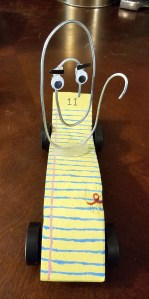
After giving myself a break, I did have a burst of creativity (before I immediately overdid it and set back my recovery). I was able to create a Clippy Pine Derby car for work. I was able to create a one shot set in the Age of Magic and lay the groundwork for an Ambergrovian campaign—including, most recently, beginning to create an Ambergrove Compendium in Foundry Virtual Tabletop (putting the Ambergrovian Adventurer’s Guide into the program for running D&D games in this world). I attended events and ran games. I completed a few rounds of editing. I took on greater tasks at work. All it took was some time not trying do do something creative and I was able to scratch that itch again in no time.

Redirect, and the Writing Will Come
And yet, for one reason or another, sometimes the best thing isn’t to push through or stop altogether but to redirect. When I was laid off last year, it was really difficult for me to come up with creative writing when I was so consumed with worry about the future. Writing a book and working in the world I created was just too overwhelming, so I slowed down an redirected. That was when I started writing short fiction for anthology submission calls. What I wrote then was on a smaller scale. There were lower stakes. Most of the stories were limited at a few hundred or a few thousand words, maximum, so there wasn’t room to get lost in the weeds. It was through this writing of short fiction that I was selected for publication in an anthology that releases in a few weeks.
Though this mode of combating writer’s block had been helpful last year, when I hit my head, I didn’t think of using it. First, I tried to push through. After a thorough scolding from a handful of doctors, I then took a break. After a restless few months, temporary recovery before collapse, and then a bit of despair, one of those doctors recommended a redirection.
Pushing through caused harm, and taking a break caused harm because I’d been so restless that I’d immediately undone the positive effects of that break. However, if I were to keep going—just slowly—then the bite-sized pieces would prevent a backslide just as they had allowed me to ease back into working creatively before. Because of the state of my brain, rather than getting back into creating short fiction from scratch, the recommendation was a bit unorthodox: fan fiction.
Now, I wrote fan fiction when I was a teen. Many writers did; that’s where a lot of us start. Writing a story where the characters are created, the world is created, and the character interactions within that world are largely created lowers the stakes greatly and allows the writer to supplement their own creativity with someone else’s. Fanfics are not typically seen outside of circles wherein they are appreciated like AO3, or in my teen years, Mibba.
Fanfics are often seen as low-hanging fruit, and they are, but they are also gateway stories. If my brain was just going to continue to attack the low-hanging fruit (the description given by the neurologist for how my self-doubt has flared up with a vengeance), the least I could do was pick more of that fruit to replenish myself. Writing is writing, and as long as you don’t plagiarize in future works outside the fanfiction genre, fanfiction writing is a healthy redirection that can allow you to continue to work that creative part of your brain without strings or fears.
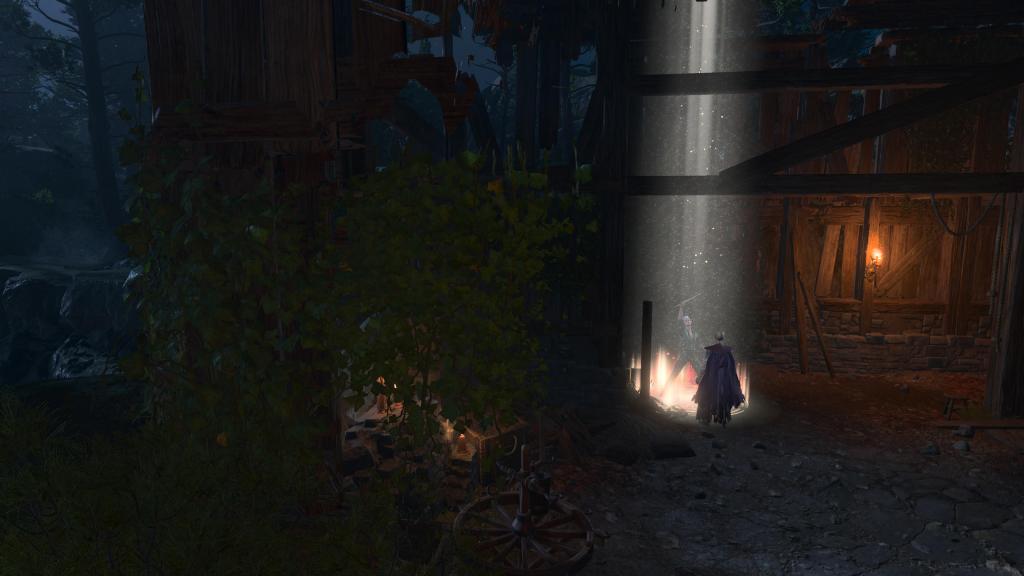
So I plotted a fifteen-chapter Baldur’s Gate 3 fan fiction, did some “research” in a couple Origin playthroughs, and began writing. After months of writing very little, I have written a whole chapter. Does it follow the game events that were already established? Yes. But it’s also written in my style. The tone matches my connection to the characters, and the internal dialogue and story trajectory matches how I feel about their development. I am excited to write it. I am happy just sitting and writing, which hasn’t been the case in years. I have enjoyed it, of course, but when writing original work in Ambergrove, the more I write, the greater the weight is on my shoulders—concerns about continuity, Imposter Syndrome, and the knowledge that Ambergrove is my world and anything I do reflects upon that world.
Historically, once I “grew out of it,” I have had very little respect for fan fiction, viewing it as childish self-insert writing alone (as it was for me when I wrote it), but just because that’s all it was for me does not mean that’s all it can be. There’s no Imposter Syndrome here—because I know that I am not one of the professional writers, and I am not trying to be one. That is, except for when an image of me with a comically large mustache in the Larian writers’ room crosses my mind.
Listen to Yourself
As I’m sure is clear from the often rambling nature of my blogs the past few months, I am still struggling quite a lot during this healing process. My wordfinding and memory skills have suffered lasting damage, and I have been trying for months to get back to where I was intellectually and creatively. Sometimes the best thing for us is to push on, sometimes that’s to stop and take a break, sometimes that’s to redirect and try something new, small, or long forgotten. Whatever the case may be—one or all—the key is to listen to yourself. If you don’t think you can push on but are going to anyway, listen to yourself and stop. If stopping is driving you crazy, try redirecting to short fiction, world building, fanfiction, or even non-literary creative pursuits like painting or cosplay. If redirecting makes you feel a powerful drive to return to your work in earnest, try pushing forward with it once more.
At the end of the day, although our writing can often take over much of our own worlds, it flits into the worlds of others. The pressure we impose on ourselves to push on only really comes from us. If we look at writing as a wheel and at the act of writing as a threefold cycle, we eliminate some of that imposed pressure, broaden our options, and allay some of our fears and self-imposed pressures.
As long as a wheel exists, it can keep turning. The speed in which it turns doesn’t add or subtract value. As long as you’re moving, you’re trying to turn that wheel just a little, you’re going everything you should be.
As we near the midpoint of 2025, I am sure that, like me, there are other writers looking back incredulously at the half-past year and wondering whether they’ve done anything worthwhile.
You have.
Keep at it. Dial back the pressure you impose on yourself, turn the wheel a little, and try the next thing.

 Tales of Ambergrove